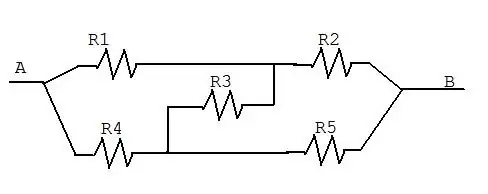
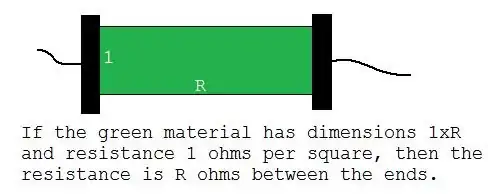
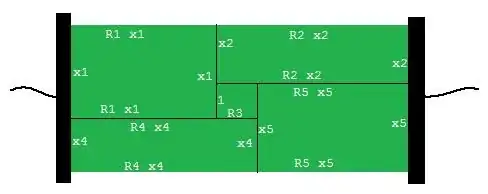
Following on from A Googler's comment to Carl Brannen's answer:
But I think $R_1x_1=R_4x_4−R_3$ and $R_5x_5=R_2x_2−R_3.$ What I'm doing wrong? Please explain
If you follow this correction through, (ie. swap your subscript 1's and 4's, and 2's and 5's in your opening horizontal consideration - the vertical statements do not need changing), then you achieve a similar result to:
$$
R = L/W = \frac{R_1R_4(R_2+R_5)+R_2R_5(R_1+R_4)-R_3(R_4+R_5)(R_1+R_2)}{(R_2+R_5)(R_1+R_4)-R_3((R_1+R_2)+(R_4+R_5))}.
$$
but without the negative signs of each $R_3$ term:
$$
R = L/W = \frac{R_1R_4(R_2+R_5)+R_2R_5(R_1+R_4)+R_3(R_4+R_5)(R_1+R_2)}{(R_2+R_5)(R_1+R_4)+R_3((R_1+R_2)+(R_4+R_5))}.
$$
This result also gives the correct results for both R tending to 0 and also R tending to infinity, but the definitions of the R's are now consistent with the diagram.
Here are some steps:
We have:
$$
R_1x_1 = R_4x_4 - R_3,
$$
$$
R_5x_5 = R_2x_2 - R_3.
$$
Using also:
$$
x_1 = x_2 + 1,
$$
$$
x_5 = x_4 + 1,
$$
and eliminating $x_1$ and $x_5$ from the horizontal equations, we get:
$$
R_1x_2 + R_1 = R_4x_4 - R_3,
$$
$$
R_2x_2 - R_3 = R_5x_4 + R_5.
$$
These solve to give:
$$x_4 = \frac{R_1R_5 + R_1R_3 + R_1R_2 + R_2R_3}{R_2R_4 - R_1R_5}
$$
$$x_2 = \frac{R_1R_5 + R_3R_5 + R_3R_4 + R_4R_5}{R_2R_4 - R_1R_5}
$$
$$
x_1 = \frac{R_2R_4 + R_3R_5 + R_3R_4 + R_4R_5}{R_2R_4 - R_1R_5}
$$
$$x_5 = \frac{R_1R_3 + R_1R_2 + R_2R_3 + R_2R_4}{R_2R_4 - R_1R_5}
$$
$$W = \frac{R_3(R_1+R_2+R_4+R_5) + (R_2+R_5)(R_1+R_4)}{R_2R_4 - R_1R_5}
$$
$$
L = \frac{R_3(R_1+R_2)(R_4+R_5) + R_1R_4(R_2+R_5) + R_2R_5(R_1+R_4)}{R_2R_4 - R_1R_5}
$$
and finally
$$
R = L/W = \frac{R_1R_4(R_2+R_5)+R_2R_5(R_1+R_4)+R_3(R_4+R_5)(R_1+R_2)}{(R_2+R_5)(R_1+R_4)+R_3((R_1+R_2)+(R_4+R_5))}.
$$
Interestingly, if the resistors $R_1, R_2, R_4, R_5$ all have the same value, say $\rho$, then it can be shown that the resistance of the entire circuit will not depend on $R_3$ at all and will instead just be equal to $\rho$.