The usual solution to this kind of problem uses a $Y-\Delta$ transformation
First, you redraw your circuit like so:
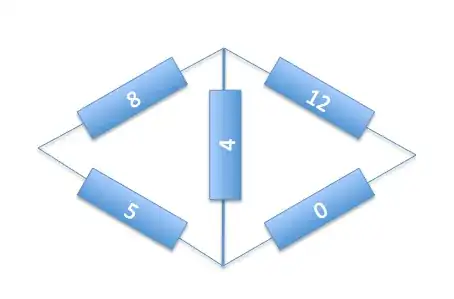
Next, you use the Y-\Delta transformation on the 5, 8, 4 Ohm "Delta" on the left; this gives you a new circuit that looks like this:
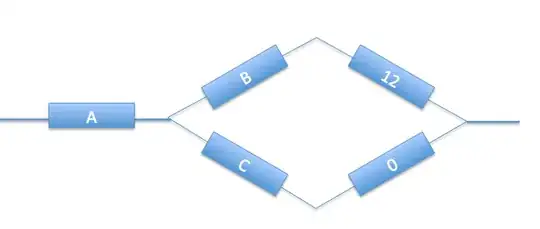
Now you just have to find the values of A, B and C; finally, you recognize that the circuit is now comprised of
$\mathbf{A}$, in series with a parallel combination of {$\mathbf{(B+12)}$ in parallel with $\mathbf{(C+0)}$}.
And that is something you should be able to do, using the equations in the link given. As an example, $R_A$ is given by
$$R_A = \frac{8*5}{8+5+4} = \frac{40}{17}$$
I will leave the rest as an exercise for you.
Note - since one of the resistors is zero, there is an easier way to do this particular problem, as shown in Anthony X's answer. But the above is more general, and works when all the resistors are non-zero.


