4

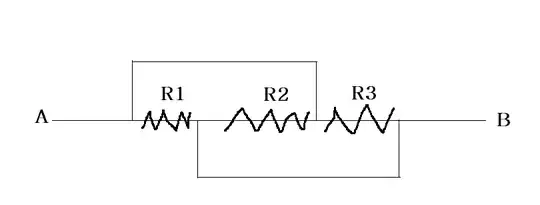
In my previous Phys.SE question, situated here, I asked about finding the equivalent resistance of the following circuit : Circuit 1

I got some very good answers and some tips. Now what if the same circuit is modified by adding two more resistors on the free connecting wires like this :
Circuit 2

How should I find the equivalent resistance now ?
I probably can't redraw the circuit as mentioned in answers to my previous question since every wire has a resistor on it.

A Googler
  • 421

5 Answers5

3

If you have a circuit like this, that cannot be simplified by the serial circuit or parallel circuit law, you should check out the star-delta transform (http://en.wikipedia.org/wiki/Y-%CE%94_transform).

General Kirchhoff laws will also work of course.

Andreas H.
  • 2,180
2

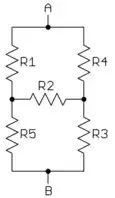
The way you have the circuit drawn is obscuring the topology. Schematics should clarify, not obfuscate. It also helps to draw them neatly.

Here is a schematic drawn to make things more obvious:

Hopefully you can now see a strategy to solve this.

Olin Lathrop
  • 13,084
1

You diagram is exactly the same as the bridge example on Wikipedia's Y-Δ transform page. After the transforms (shown in that example) it becomes trivial.

Dan
  • 111
0

The diagram is a network of wheatstone bridge, but it should satisfy the condition after which it is easy to calculate the net resistance between the points

The R2 resistance will be in the middle and will be neglected if the condition of wheatstone bridge is satisfied, i.e. R1.R4=R5.R3

Kyle Kanos
  • 29,127
0

This circuit can be redrawn into a simpler version. The circuit so formed will exactly resemble as the "Wheatstone's bridge" with a resistor in place of a galvanometer(which is commonly used for checking slightest of the current passing through it).

First mark the points at the junctions as "1","2","3","4" respectively from left to right. Then you can observe that point 1 to point 2 has resistor no.1.so draw it first. Then we can observe that point 1 to point 3 has resistor no. 4, so draw Resistor no. 4 from the point1 (marked before) to point3. Now we see that point 2 to point 3 has resistor no. 2 in between, so draw it between the points 2 and 3 (both points are marked in the earlier steps so just draw a resistor between them). Now draw resistor 3 and resistor 5 from points 3 and 4 respectively to point 5. Now point 1 resembles point "A" and point 5 resembles point "B"(as no resistor is placed between point "A" and point 1 and between point "B" and point 5). Hint: Draw the straight i.e. without any curve between two points.

You'll observe that a Rhombus resembling Quadrilateral is formed with a resistor on all its side and a diagonal. Prefer to draw same size of the wire. For solving and knowing more about the Wheatstone's bridge thus formed.
Kyle Kanos
  • 29,127