6

I know that the 2-vertex $\Gamma^{(2)}$ is the second derivative of the effective action, but I fail to see what it is diagrammatically: is it the truncated 1PI diagram? The non-truncated one?

If this helps, the trouble comes from the identity, in massless $\lambda\phi^4$ theory, that states $$\Gamma^{(2)}=G^{-1}=P^{-1}-\Sigma\tag{1}$$ where $G$ is the propagator, $P$ is the free propagator, and $\Sigma$ is the self-energy. I understand why $$G^{-1}=P^{-1}-\Sigma\tag{2}$$ (using the geometric series), but I fail to see what $$\Gamma^{(2)}=G^{-1}\tag{3}$$ means in terms of diagrams.

2 Answers2

4

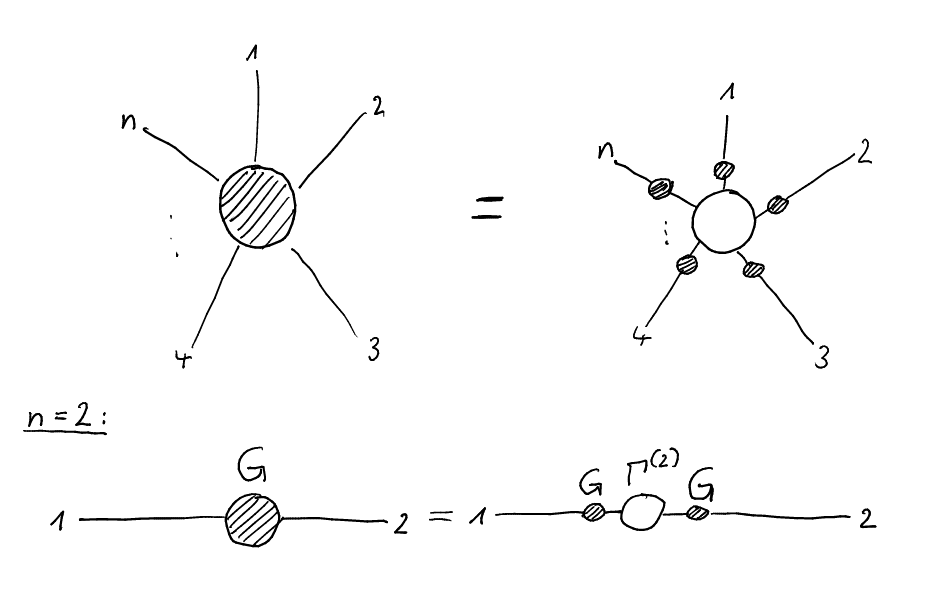
The 1PI effective action $\Gamma[\phi]$ generates the 1PI connected amputated Green's functions. Let us denote the connected fully resummed non-amputated vertices by shaded circles, and the 1PI amputated vertices by empty circles.

Diagrammatically:First row: A shaded circle with n legs equals an empty circle with n legs which each have a shaded circle in their middle. Second row: A line with a shaded circle in its middle equals a line with a shaded circle, an empty circle and then a shaded circle in its middle

Note that the row for $n=2$ is $G = G\Gamma^{(2)}G$, which is the same as $\Gamma^{(2)} = G^{-1}$.

If you think about it, this is just drawing what amputated means: $\Gamma^{(n)}$ is the fully resummed vertex with all the fully resummed propagators $G$ removed from the legs.

ACuriousMind
  • 132,081
2
  1. OP is correct that the diagrammatic interpretation of the self-energy $\Sigma$ as (a sum of) amputated diagrams comes from the geometric series (2), cf. e.g. this Phys.SE post.

  2. OP is also correct that the diagrammatic interpretation of eq. (3) is less clear. Eq. (3) is inherit from the Legendre transformation$^1$ between the generator $W_c[J]$ of connected diagrams and the effective action $\Gamma[\phi_{\rm cl}]$. Note that eq. (3) gets modified in the presence of tadpoles, cf. e.g. my related Phys.SE answer here.

References:

  1. S. Weinberg, Quantum Theory of Fields, Vol. 2, 1996; eq. (16.1.21).

--

$^1$ Eq. (3) often contains a minus, cf. e.g. Ref. 1.

Qmechanic
  • 220,844