3

I'm asked to calculate the average Kinetic and Potential Energies for a given state of a quantum harmonic oscillator. The state is: $$ \psi(x,0) = \left(\dfrac{4m\omega}{\pi\hbar}\right)^\frac{1}{4}e^{\frac{-2m\omega}{\hbar}x^2} $$ The thing is, calculating $\langle T\rangle=\int_{-\infty}^{\infty}\psi(x)(-i\hbar)^2\frac{d^2}{dx}\psi dx=\left(\dfrac{4m\omega}{\pi\hbar}\right)^\frac{1}{2}\int_{-\infty}^{\infty}e^{\frac{-4m\omega}{h}x^2}dx-\left(\dfrac{4m\omega}{\pi\hbar}\right)^\frac{1}{2}\int_{-\infty}^{\infty}x^2e^{\frac{-4m\omega}{h}x^2}dx=\hbar\omega$

Where I used that the momentum operator is $p=-i\hbar\frac{d}{dx}$

$\langle V\rangle=\dfrac{m\omega^2}{2}\left(\dfrac{4m\omega}{\pi\hbar}\right)^\frac{1}{2}\int_{-\infty}^{\infty}x^2e^{\frac{-4m\omega}{h}x^2}dx=\dfrac{\hbar\omega}{16}$

But then the Virial Theorem is not satisfied. I've read the virial theorem holds for any bound state and all states in a Quantum Harmonic Oscillator are bound. Can someone point out where I am going wrong? Thank you

Qmechanic
  • 220,844

2 Answers2

3

The ground state of the harmonic oscillator is (see Wikipedia for example): $$\psi_0(x) = \left(\frac{\alpha}{\pi}\right)^{1/4} e^{-\alpha x^2/2},\quad \quad \text{where }\quad \alpha =\frac{ m \omega}{\hbar}$$

Your math is correct, it's just that the state you have is not a bound state of the harmonic oscillator, the parameters are slightly off. If you use the state provided above, you can indeed show that: $$\langle T \rangle = \frac{\hbar \omega}{4} = \langle V \rangle.$$

Philip
  • 11,520
3

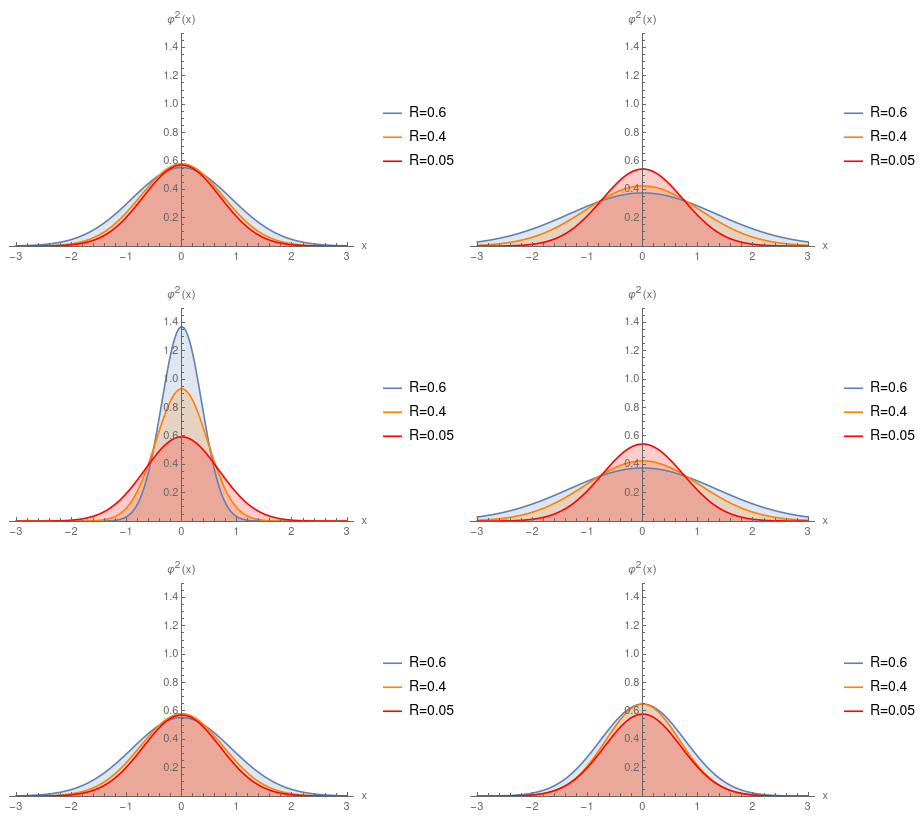
You can have Gaussian fields that are not eigenstates, but then they are not time independent -- and time independence is the essential element of the virial theorem. For example, the harmonic oscillator time-dependent Schrödinger equation $$ i\frac{\partial \psi}{\partial t} = -\frac 12 \frac {\partial^2 \psi}{\partial x^2} +\frac 12 \omega^2 x^2 \psi $$ has a time-dependent solution $$ \psi(x,t)= \left(\frac{\omega}{\pi}\right)^{1/4}\frac 1{\sqrt{e^{i \omega t} +R e^{-i\omega t}}}\exp\left\{ - \frac \omega 2 \left(\frac{1-R\,e^{-2i\omega t}}{1+R\,e^{-2i\omega t}}\right)x^2\right\}, $$ where the parameter $|R|<1$. Only if $R=0$ are its $x$ and $p$ distributions time independent. If $R\ne 0$ the gaussian "breathes" in and out. Your wavefunction is a snapshot of this one at some particular time.

Below is a visualisation of $|\psi(x,t)|^2$ (taking $\omega=1$) for different values of $R$, showing how the Gaussian "breathes". As you can see, as $R\to 0$, the probability distribution tends to not change as much.

                          enter image description here

Philip
  • 11,520
mike stone
  • 58,971
  • 4
  • 53
  • 158