13

Suppose I have a caliper that is infinitely precise. Also suppose that this caliper returns not a number, but rather whether the precise length is rational or irrational.

If I were to use this caliper to measure any small object, would the caliper ever return an irrational number, or would the true dimensions of physical objects be constrained to rational numbers?

Qmechanic
  • 220,844

13 Answers13

23

The set of irrational numbers densely fills the number line. Even assuming that quantum mechanics doesn't disable the preimse of your question, the probability that you will randomly pick an irrational number out of a hat of all numbers is roughly $1 - \frac{1}{\infty} \approx 1$.

So the question should be "is it possible to have an object with rational length?

15

Is it possible for a physical object to have an irrational length?

It's a bit of a philosophical question, but one could say this:

Just for fun, assume you have a perfect 45-degree right triangular piece of metal whose base and height is rational. Then it's hypotenuse is irrational because its length is the base times $\sqrt{2}$.

So it is possible to have a physical object of irrational length IF you can have a physical object of rational length.

ADDED: Suppose you cut a 45-degree right triangle out of a material based on a square atomic lattice, so the base and height each consist of $N$ atoms separated by $d$. Then the hypotenuse consists of $N$ atoms separated by $\sqrt{2}\times d$, so it's still not rational.

Suppose instead the material is based on a hexagonal lattice. Then all inter-atomic spacing would be $d$, but it would be impossible to cut a perfect 45-degree triangle out of it. In fact, the only triangle with rational sides you could cut out of it would be equilateral.

Mike Dunlavey
  • 17,328
8

Suppose your infinitely precise caliper gives the answer $2.00000000000000\dots$ How would you know whether this is $2$ exactly, or if somewhere past the trillionth decimal it starts to deviate from $2$? How would you read your infinitely precise caliper?

6

physical objects do not have well-defined lengths (there is this thing called quantum mechanics conceived in its entirety upon this concept). A more interesting question is if dimensionless numbers in physics can be irrational, for instance, the ratio between the mass of the electron and the proton.

Theoretically, we will need a numerical expansion and some limiting argument to tell to what domain of the reals the limit belongs (irrational, transcendental, rational). Experimentally this can never be asserted, as naturally all experimental numbers are known with a finite number of digits of precision

lurscher
  • 14,933
6

One can give an argument based on measure theory and the like, but one must not forget that physics is about measurement. The question whether the length can be rational or irrational would need an infinitely precise measurement, which is not possible (measurements bear an error). Hence this question cannot be answered from the physics viewpoint. Any answer will be just speculation.

c.p.
  • 1,564
2

If we assume that the universe is continuous, and say fix everything at a certain time frame. Then everything has an irrational length, regardless to how well we can measure it. Simply because we can define a unit of measure whose result would be irrational.

For example, measure my foot. Now define the unit of measure $1\ \small\bf Karf$ to be the square root of twice the length. Then my foot would be exactly $\sqrt\frac12\ \small\bf Karf$ long. As we know $\sqrt\frac12$ is irrational.

But this requires the assumption that the universe is continuous and that we can freeze time and measure with infinite precision. If the universe is discrete, or if we cannot measure accurately, then we can't really say too much. Not to mention that everything changes all the time (cells falling off, atoms released, etc. etc.) so there's no constant length to anything large enough.

2

Let's take the smallest possible case of such a triangle. It would be made of three atoms of equal size, linked together in a L-shape with a 90° angle in between.
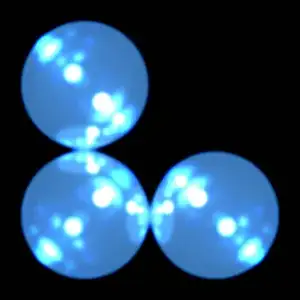
three hypothetical atoms

If you have an arrangement like that, and something similar might be chemically possible, the centers of mass of the more distant two atoms would be apart [exactly][1] $\sqrt{2}\times$the distance between the directly touching ones.

Presumably, if you take a more rigorous and accurate approach, if you look at the bonding structure of water (which, of course, won't feature a right angle but the situation is equivalent), the centers of mass of the two Hydrogen atoms would also be an irrational distance appart compared the the distances of the centers of mass of each Hydrogen to the Oxygen. No matter what scale you use, at least one of the two distances will always be irrational.

If you can somehow limit the set of all possible distances to a countable infinity, I'd suspect this set not to be the rationals but rather the algebraic numbers. (or at least the subset of them that are positive)

[1]: modulo Heisenberg but I didn't use proper orbitals either. Let's, for the sake of the argument, define a distance on quantum level by the distances of expected values of the corresponding probability clouds.

kram1032
  • 249
1

I think that because you have measurements that are real numbers not isomorphic to the natural numbers or countably infinite, you firstly have assumed the universe infinitely dense. Therefore any measurement as mentioned in some other answer's would justly be required to have infinite many decimal points.

This is seen from the fact that the set of real numbers can be viewed as a set of infinite sequences of integers. Because measurements are positive, any measurement can be represented in the form $r = \sum_{i=0}^{\infty}\frac{a_i}{10^i}$ such that $a_0 \in \Bbb N$ and for $ i>0; a_i \le 9$. Then $r$ is defined as the limit as $i$ to $\infty$.

So in short you can see the irrational measurements just correspond to specific types of sequences above where they do not repeat.

Rather then going further in defining the integer sequences, I would like to consider other notions as well. The possible measurements are not countable!

Keep in mind that though traditionally the mathematics used in physics are defined over the reals or complex, they typically correspond to sets isomorphic to the integers or that are countable in actual calculation.

It seems that mathematics considers the realm of possibility (where some reals aren't even definable), I do not know if it corresponds to the constituents of the universe.

1

If you are talking about real, physical objects, then your question collapses completely, because such objects are composed of particles which have no definite positions and momenta according to Heisenberg's uncertainty principle.

So lets stick to a stick in classical mechanics, then your caliper can return irrational numbers.

But a mathematical line-segment doesnt even have to have rational or irrational length, it could have an even 'finer' scale, a so called non-standard number.

fisk
  • 11
1

From the point of view of measure theory, the probability of measuring a rational length is actually zero.

Consider, without loss of generality, the interval $[0,1]$. Using the standard Lebesgue measure, the measure of this set (its length) is 1. If we consider the subset which consists of all the rational numbers from this set, its measure is actually 0. This starts to make sense if one considers how miniscule the size of the rational numbers is compared with all the other real numbers. In fact, it turns out that the only subsets of our interval with non-zero measure are continuous ones (eg $[a, b]$, where $a<b$ and the measure is $b-a$) and ones that contain so-called normal numbers. Only the normal numbers are said to 'take up any space' on the real number line. That is, virtually all the real numbers are actually normal numbers (which can never be written down on paper), and so the probability of measuring anything that's not a normal number is 0.

http://en.wikipedia.org/wiki/Normal_number

Ethan
  • 410
0

The hypotenuse of a right angled triangle with legs 1 is irrational.


Alternatively, consider a pyramid. As you take measurements of the 'base length' towards the apex, you get a continuous sets of values. One of these must be irrational.

Of course, you can then start an argument about what 'physical' object is, and if length is truly continuous, or it has to be discrete because it is constructed by atoms.

0

First of all, it doesn't make sense to assign an absolute number to a physical quantity like length and volume. The number can be different with respect to different "units" of measurement.

But one can still question the ratio of two lengths, in this case:

According to the Bekenstein entropy limit(information), I guess there should be some maximum level of precision.

If a rod has an irrational length ratio, then it demands an infinite amount of information(write the length in a binary format like this sequence 11010100001000....).

Since irrational numbers don't have any pattern( repetition of a finite sequence) I guess it should be impossible to retain all that information in a Quantum Mechanical world.

Moreover one can be even more critical and accept the existence of length ratios only with a finite code(rather than a finite repetitive pattern)! so that one can deny even a rod with a non-integer rational number length ratio.

This sounds like the emergence of integers(quantas) in Quantum Mechanics!

Bastam Tajik
  • 1,310
-1

It's expected from general results in Loop Quantum Gravity, a leading contender for Quantum Gravity, that there is a minimal length that is resolvable which is of the order of Planck's length.

Since irrationals must have infinite precision, this means we should rule out objects with irrational length. In fact, we must also rule out objects with rational length, since in order to verify that they have rational length we require infinite precision.

It turns out that the continuum structure of physical geometry is quite a bit more interesting than the real line ...

Mozibur Ullah
  • 14,713