We can measure only rational numbers by our scale. Here is an example where irrational numbers does makes sense. If so then this question may have some theoretical importance. Is irrational numbers important for physics?
Asked
Active
Viewed 1,184 times


2 Answers
4
One of the directions to look at goes under the name of "commensurability". Imagine electrons that can travel on a two-dimensional lattice and suppose there is a constant magnetic field perpendicular to the lattice. Making a discrete loop on the lattice will add to the electron-wavefunction an Aharonov-Bohm phase propotrional to the area coverd by the loop. Resulting interference pattern will depend on the commensurability of the enclosed magnetic flux with the flux quantum $h/e$.
The spectrum of electrons on a lattice under as a function of magnetic field has a beautiful fractal shape known as Azbel'-Hofstadter butterfly:
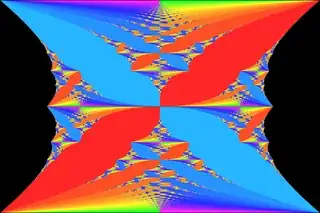
The way I see it relates to OP's question is that this spectrum has no bands if the magnetic field takes irrational values in appropriate units. Of course, since any measurement/realization precision is finite, rationals with large irreducible denominators would be indistinguishable form true (mathematical) irrationals. But I think it it still as close as it gets to physical relevance of (ir-)rationality.

Slaviks
- 4,493
0
How about the [Feigenbaum constants?],1 I'm not sure if they have been proven irrational though. Anyone know btw?

Mauchy
- 101