18

I know it's a common question but I can't find an explanation that can clearly show how it happens. If we take Bernoulli's equation, being aware of its hypothesis, it states that energy is constant between 2 given points. So if pressure drops, velocity should rise.

I know flow mass should be conserved but one thing is the mathematical explanation and also the mechanism itself. How exactly does this happen? If velocity increases, should that be due to a force. Not gravitational not surface force so, which one?

Furthermore, if liquids can't be compressed and the temperature is constant. Where is this “pressure” energy stored?

EDIT: My question stems from working with hydraulic pumps in which diffusers are used to transform velocity into pressure.

It must have something to do with the geometry of the pipe but I can't understand how a liquid flowing with velocity drops some of it to increase its pressure in a wider segment of the pipe. More space should lead to less pressure and more velocity as it has more space available.

I am looking for a more “atomistic” answer such as this one (it doesn't satisfy me completely):

According to Bernoulli's principle, the pressure of a fluid decreases when its velocity increases (for e.g., in a nozzle). What is the physical reasoning for this?

Qmechanic
  • 220,844
XcodeX
  • 181

6 Answers6

22

Q: What is the mechanism that transforms pressure into velocity?

A: Pushing.

Seriously, that's the answer. Bernoulli's equation is usually stated as “pressure drops when velocity increases”, but I find it much clearer when stated the other way around: velocity increases in a narrow part of a pipe because before the narrow part, there's a big pressure pushing the liquid into the narrow part. Inside the narrow part, the fluid is already accelerated, so that pressure isn't needed anymore to keep up the speed.

(In fact more accurately it's the pressure gradient that accelerates the fluid, i.e. the particles at the entry are strongly being pushed from behind but not so strongly resisted from ahead.)

8

Normally (excluding nuclear reactions etc.), it is the electromagnetic ("em" from here on) repulsion at the root of all. A push is nothing but electromagnetic repulsion between what is pushing and what is being pushed.

If what is being pushed is firm enough to exert equal and opposite em force, then there is no motion, even though there is pressure from both sides. Otherwise, it gets displaced by the repulsion which becomes velocity. Pressure is nothing but em repulsion per unit area.

Attraction can also cause pressure, but repulsion is a must to realize the pressure. Just like gravity (attraction), causes pressure between your feet and earth, but the pressure is only realized by the repulsion between electrons in your shoes and those in earth where you are standing.

Faster (in parallel) moving fluid/air has lesser chance of exerting that repulsion and hence bernouilli principle.

So, to answer your question, EM causes push/pressure, which causes displacement, which results into velocity.

In one of your comment - "velocity drops and pressure increases" - basically, the opposing force is firm enough to slow down the displacement and so let the pressure increase till the point it matches the source push.

LimaKilo
  • 148
kpv
  • 4,529
2

Bernouillis equation balances the energy, not the forces themselves.

Pressure is like a potential energy. It has no use until there is a pressure differential to act on. When the pressure is allowed to act.on a differential, fluid flows from high to low pressure. This does create a force on the fluid, causing it to speed up.

Since we already know pressure and want velocity, finding the force on the fluid itself is a wasted step. Instead, you can use the energy balance to relate a change in pressure directly to a change in velocity. It's a simple matter of assuming no net energy loss and that only pressure and velocity will change.

The pressure energy is stored in whatever container can hold the pressure. If there's an open end, the fluid will go through the open end and lose that pressure. That lost pressure will become velocity through conservation of energy. Pressure itself isn't usable energy, you need a pressure difference to get use out (same thing applies with voltage potential and it also happens with temperatures ).

JMac
  • 15,595
2

Lets start with where the pressure energy is stored.

No liquid is really incompressible, only nearly so. The particles have a very strict idea about how far apart they "want" to be, but they can be convinced to crowd slightly closer together.

And that is what high pressure is, particles crowded uncomfortably close together. You can visualize this as every particle pushing on its neighbours but nobody moving much because this push comes from all directions. Particles also push on the container, but the container pushes right back.

This is potential energy. You can visualize it as a small compressed spring between every pair of too close neighbours.

And then suddenly there is an opening where particles can escape! The first layer of particles is pushed only from one side and is ejected at high speed, then the second layer becomes the new outermost layer and is ejected in turn. And so on.

Now the energy in those compressed springs have been turned into kinetic energy.

1

I think I can add something to other people's explanations. Some people have mentioned that higher pressure means larger stored energy (potential energy). This is correct. And also that this pressure is responsible to accelerate the particles to the higher velocity at a narrowing. This is also true. However, it is not correct to say that the lowering in pressure comes as a result of the conversion from potential energy to kinetic energy. That is, it is not that the particles have less kinetic energy (which would mean lower temperature).

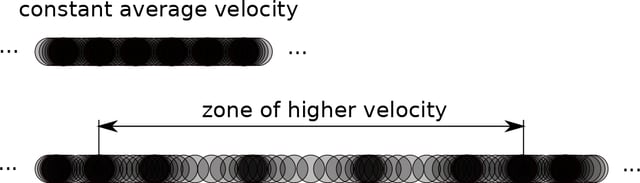
What actually happens is that the particles are moved on average further apart in the higher velocity zone (see figure below)
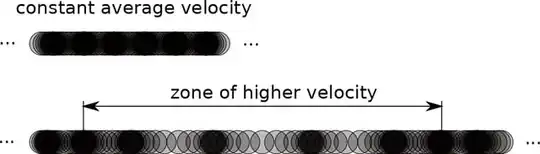
molecular description of 1-d acceleration zone

The figure represents a 1-d model of a train of vibrating molecules travelling from, say, left to right at a constant velocity (top image) until they encounter a zone of higher velocity (lower image). The circles represent a sample of the particles' positions, such that more likely positions have more circles clustered near them.

Just as in the flow of molecules in a pipe, one must imagine the molecules vibrating back and forth. This vibrating motion is superposed over the average velocity left-right. The temperature of the fluid gives the average kinetic energy of the molecules due to the random motion (subtracting the component due to the average velocity). When the particles pass through a zone of higher velocity (such as a narrowing in a pipe), they become more separated, making the frequency of collisions smaller. This is mainly what causes the lowering of pressure, since a smaller number of impacts per unit time and area leads to a lower total force per unit area.

It is true, as others have noted, that the particles use part of their kinetic energy to accelerate, lowering their temperature slightly. However, this is normally a very small fraction of their vibrating velocity, so that the change in temperature is small. The change in distance between the particles is the real cause of the drop in pressure (potential energy turns into kinetic energy).

I hope this explanation helps you and others understand this commonly asked question. I would also like to point out that this question has been asked in this site, with variations, in other occasions:

How can we intuitively understand the idea that when the velocity of fluid increases, the pressure of fluid decreases?

Why is pressure greater in an open part of a tube than in a constricted one?

Also related is

Why decrease in velocity will increase pressure?

Complementary explanations are given in

Microscopic source of pressure in an incompressible fluid

0

When you reduce the outlet cross-section, the velocity upstream of the pipe will decrease (compared to the velocity without reducing the outlet cross-section) because the flow is obstructed (compared to the flow without reducing the outlet cross-section, the flow is obstructed).

Therefore, the pressure upstream of the pipe will increase (just like when flowing water collides with an object blocking the flow, the velocity will decrease and the pressure will increase).

And once the pressure increases, the velocity at the outlet section will increase. Because the pressure at the entrance of the exit has increased. It should be acknowledged that exports also have a certain length, but the length is relatively short. The exit cross-section gradually decreases in this section.

If the outlet cross-section is further reduced, due to the small cross-section over a certain length, there will be significant losses when the water flows, which will offset the increase in pressure. As a result, the velocity of the water will decrease, or even completely stop flowing. This is equivalent to turning off the faucet.

So the reason for the increase in speed is that the pressure at the inlet section of the outlet has increased.

If you push a stone with great force, the speed of the stone will naturally increase.

So your question is like asking: why does a large force cause a large acceleration?

So it's not that big pressure is converted into big speed, but that big pressure difference leads to big acceleration, hence big speed.

enbin
  • 2,306