21

Another interesting infinite lattice problem I found while watching a physics documentary.

Imagine an infinite square lattice of point masses, subject to gravity. The masses involved are all $m$ and the length of each square of the lattice is $l$.

Due to the symmetries of the problem the system should be in (unstable) balance.

What happens if a mass is removed to the system? Intuition says that the other masses would be repelled by the hole in a sort of "anti-gravity".

  • Is my intuition correct?
  • Is it possible to derive analytically a formula for this apparent repulsion force?
  • If so, is the "anti-gravity" force expressed by $F=-\frac{Gm^2}{r^2}$, where $r$ is the radial distance of a point mass from the hole?

Edit:

as of 2017/02 the Video is here (start at 13min): https://www.youtube.com/watch?v=mYmANRB7HsI

Helder Velez
  • 2,685
Sklivvz
  • 13,829

4 Answers4

13

This is not correct, but Newton believed this. The infinite system limit of a finite mass density leads to an ill defined problem in Newtonian gravity because $1/r^2$ falloff is balanced by density contributions of size $r^2\rho$, and there is no well defined infinite constant-mass-density system. The reason is that there is no equilibrium of infinite masses in Newtonian gravity--- you need an expanding/contracting Newtonian big-bang.

This is subtle, because symmetry leads you to believe that it is possible. This is not so, because any way you take the limit, the result does not stay put. This was only understood in Newtonian Gravity after the much more intricate General Relativistic cosmology was worked out.

3

I think that your initial intutiion is right--before the point particle is removed, you had (an infinite set of) two $\frac{G\,m\,m}{r^{2}}$ forces balancing each other, and then you remove one of them in one element of the set. So initially, every point particle will feel a force of $\frac{G\,m\,m}{r^{2}}$ away from the hole, where $r$ is the distance to the hole. An instant after that, however, all of the particles will move, and in fact, will move in such a way that the particles closest to the hole will be closer together than the particles farther from the hole. The consequence is that the particles would start to clump in a complicated way (that I would expect to depend on the initial spacing, since that determines how much initial potential energy density there is in the system)

1

I assume by square lattice you mean a 3D cubic lattice because there's no translational symmetry along the $z$-axis for a 2D square lattice.

Suppose the masses are located at $(n_x, n_y, n_z)$ where $n_{x,y,z}\in\mathbb Z$. Let's also define the unit of mass and length so that $m=l=1$.

Consider the total force acted on the mass point at (0, 0, 0) just due to the 1st octant $(x>0,y>0,z>0)$: $$\begin{aligned} \mathbf F_{+++} &= -G \sum_{n_x=1}^\infty \sum_{n_y=1}^\infty \sum_{n_z=1}^\infty \frac{n_x \hat{\mathbf x} + n_y \hat{\mathbf y} + n_z \hat{\mathbf z}}{(n_x^2+n_y^2+n_z^2)^{3/2}} \\ &= -G \left( \hat{\mathbf x} \sum_{n_x=1}^\infty \sum_{n_y=1}^\infty \sum_{n_z=1}^\infty \frac{n_x}{(n_x^2+n_y^2+n_z^2)^{3/2}} + \dotsb \right), \end{aligned}$$ however, the sum actually diverges, since, $$\begin{aligned}\sum_{n_x=1}^\infty \sum_{n_y=1}^\infty \sum_{n_z=1}^\infty \frac{n_x}{(n_x^2+n_y^2+n_z^2)^{3/2}} &\ge \int_1^\infty \int_1^\infty \int_1^\infty \frac{n_x}{(n_x^2+n_y^2+n_z^2)^{3/2}} dn_x dn_y dn_z \\ &= \int_1^\infty \int_1^\infty \frac1{\sqrt{1+n_y^2+n_z^2}} dn_y dn_z \\ &= \infty, \end{aligned} $$ so while symmetry suggests that the force at center is 0, mathematically it is not well defined.


Of course, if we assume the net force can be well-defined as 0 (e.g. the gravity actually decays faster than $1/r^3$!), then Points 1 and 3 are correct. When we remove a particle from the lattice, the contribution $-\frac{GMm\hat{\mathbf r}}{r^\alpha}$ will be subtracted from it, so it is as if there is a particle of negative mass $-m$ put to that point. This is because force is additive and gravity is proportional to mass.

(Yeah this is stating the obvious.)

kennytm
  • 2,593
-1

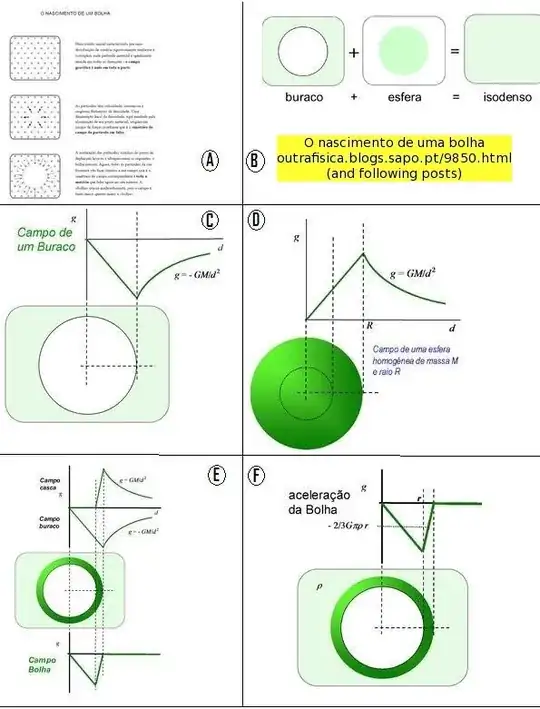
Your intuition is OK. This apparent «anti-gravity» is just the usual attractive gravity. The problem is treated analytically, in a light way (*), starting in the post O nascimento de uma Bolha (The birth of a Void). For convenience I grabbed a few images from the blog (CC license) and I adapted some legends.

Image A-top - The gravitational field is null everywhere in an uniform and isotropic distribution.
Image A-middle - due to fluctuations particles acquire motion, and a local defect of density, here represented by a removed particle, originates a field that is symetric of the field of the missing particle.
Image A-bottom - The acceleration of particles surrounding the point of depletion leads them to exceed the following ones; Now, every particle of its boundary will be subject to a field corresponding to all matter that is missing inside. The "Void" grows rapidly because the field grows as the "Void" grows.
Image B -- void + sphere = isodense
Image C -- The field of a void
Image D -- The field of an homogeneous sphere, mass M and radius R.
( graphs C+D = 0 )
Image E -- The fields considering the outer shell
Image F -- The acceleration of the Void.

I already did a simulation of a lattice respecting this conditions (tricky because it is an infinite universe ;-) and the result is the same as I show in this answer.

(*) a complete mathematical treatment is known to me since 1992/Oct and it will be the subject of a paper by my friend Alfredo, as the author states in the last page of his recent paper A self-similar model of the Universe unveils the nature of dark energy (no peer reviewed). It will be shown that the evolution of the initial homogeneous and uniform universe, with T=0, will match the observed large-scale structure of the universe (without DM).

The birth of a Void:

The birth of a Void

Helder Velez
  • 2,685