Questions tagged [gravitational-lensing]

Gravitational lensing occurs when light from a distant object is bent as it travels to an observer, due to passing through the gravitational field of a massive object (such as a galaxy, or black hole).

Gravitational lensing occurs when light from a distant object is bent as it travels to an observer, due to passing through the gravitational field of a massive object (such as a galaxy, or black hole).

Spacetime around a massive object (such as a galaxy cluster or a black hole) is curved, and as a result light rays from a background source (such as a galaxy) propagating through spacetime are bent. The lensing effect can magnify and distort the image of the background source.
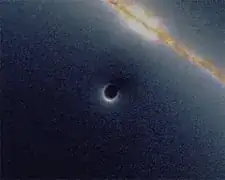
Simulated gravitational lensing

218 questions
57
votes
4 answers

Do gravitational lenses have a focus point?

Do gravitational lenses have a focus point? Could I burn space ants?
Jitter
  • 2,477
43
votes
5 answers

How does gravitational lensing account for Einstein's Cross?

Einstein's Cross has been attributed to gravitational lensing. However, most examples of gravitational lensing are crescents known as Einstein's rings. I can easily understand the rings and crescents, but I struggle to comprehend the explanation…
27
votes
1 answer

The transit of Venus and solar neutrino rates

The following question was posed at the end of Maury Goodman's June 2012 long-baseline neutrino newsletter. During the Venus transit of the sun, were more solar neutrinos absorbed in Venus, or focused toward us by gravity? As I don't know off…
26
votes
2 answers

How does one measure the mass of a galaxy? And other such large quantities?

Trained as a pure mathematician, I see claims about the mass of a galaxy and other such huge measurements that are arrived at experimentally, and I just have to scratch my head. I know this is a bit of a vague question--but does anyone have a good…
23
votes
9 answers

Does Newtonian mechanics predict the bending of the course of light by objects with mass?

$$F=G m_1 m_2/d^2$$ $$F=ma$$ $$a_g=Gm_{\rm other}/d^2$$ In Newtonian mechanics, the acceleration of object A toward object B is not dependent on the mass of object A but on the mass of object B and the distance between objects A and B. Because the…
22
votes
1 answer

Do gravitational lenses work on gravitational waves?

Do gravitational lenses work on gravitational waves? Could we get an Einstein cross of gravity?
Jitter
  • 2,477
18
votes
5 answers

Does 'special relativity + newtonian gravity' predict gravitational bending of light?

It seems to me that special relativity (SR) already predicts that gravity will bend light rather than this effect being a proof of general relativity (GR). Photons have energy proportional to their frequency and according to $E = mc^2$ they also…
17
votes
1 answer

Questions about first JWST image

Why do the circled galaxies seem to form long circular arcs that surround the white point at the center? And why do most of the galaxies in this image seem to be facing that same point? What is in that point?
16
votes
1 answer

Could a black hole’s photon sphere theoretically act as a "mirror" to observe Earth’s historical light?

Could light emitted from Earth theoretically orbit a black hole’s photon sphere and return, allowing us to observe Earth’s past? If so, what fraction of photons would survive this trajectory instead of being captured or scattered? Would the…
16
votes
1 answer

Is matter - dark matter symmetry possible?

The gravitational lensing evidence suggests massive and relatively dense accumulations of dark matter in space. However, dark matter collapsing to dense regions is unlikely due to energy conservation. Could there be a different explanation of how…
15
votes
4 answers

Coulomb's Law in the presence of a strong gravitational field

I was under the impression that the $1/r^2$ falloff of various forces were because of the way the area of a expanding sphere scales. But that strict $1/r^2$ falloff would only be globally true in a strictly Euclidean geometry, yes? So, if you had an…
14
votes
3 answers

Given gravitational lensing, why would black holes visually appear black?

This image from Wikipedia, also referenced in this question, is an artist's vision of how a black hole should look like: However, given that a black hole is a gravitational lens strong enough to swallow the light rays that come too close to it,…
13
votes
3 answers

Using a naked black hole as a mirror?

http://www.youtube.com/watch?v=ENd8Sz0AFOk The YouTube video is a good example how the gravity of this merging binary black holes bend light around themselves.
11
votes
3 answers

Liouville's theorem and gravitationally deflected lightpaths

It is customary in gravitational lensing problems, to project both the background source and the deflecting mass (e.g. a background quasar, and a foreground galaxy acting as a lens) in a plane. Then, the lensing problem can be regarded as a mapping…
11
votes
3 answers

How to explain gravitational lensing to a layman?

This question is about how to explain gravitational lensing to a layman, not about exact theoretical correctness. I am accustomed to explaining optical refraction in terms of wavefronts and the fact that light moves at different speeds in different…
S. McGrew
  • 25,240
  • 3
  • 32
  • 81
1
2 3
14 15