3

I am reading the chapter 27 of the GR book MTW, which deals about cosmology. The Friedmann metric of a spacetime where the space is a 3D-sphere is:$$\mathrm ds^2 = -c^2\mathrm dt^2 + a^2(t)[\mathrm d\chi^2 + \sin^2(\chi)(\mathrm d\vartheta^2+\sin^2(\vartheta)\mathrm d\varphi^2)]$$ After calculating the connections, the Ricci tensor and Ricci scalar, the following equations (from the Einstein field equations) are obtained (I introduced G and c, not present in the book): $$\frac{1}{a^2} + \frac{a'{}^2}{a^2c^2} = \frac{8}{3c^4}\pi G\rho$$ for the $00$ (time) differential equation and $$-2\frac{a''}{a c^2} - \frac{a'{}^2}{a^2c^2} - \frac{1}{a^2} = \frac{8\pi G}{c^4}p$$ for the $ii$ (spatial) terms.

My question is: why is not mentioned the possibility of $a(t)$ be a constant, so that $a'$ and $a''$ are zero? (By the way, it is possible to imagine that Friedmann tried this before put $a$ as an $a(t)). $After all, the belief in a static universe was prevalent in that time, and if Friedmann rejected that hypothesis from the equations, it is because it must be contradictory in some way.

One reason could be that, if $a$ is constant, the pressure is a function of the energy density, what seems strange. $\rho$ and $p$ would not be 2 independent variables. Are there other (and better) reasons?

My understanding is that Einstein had to add a cosmological constant (to keep a static universe) in the field equation exactly because $a(t)$ could not be a constant.

2 Answers2

2

Conventional matter & energy sources do not have negative pressure. Non-relativistic particles like stars, galaxies, and dust have negligible positive pressure ($p \approx 0$); relativistic particles (like photons) have $p = \frac13 \rho$.

But if you want a constant scale factor from your equations above, you must have $p = - \frac13 \rho$ instead. To do this you need a mix of the conventional "dust" that we know to exist and a cosmological constant term, which is the equivalent to including a matter/energy source with negative pressure $p = - \rho$.

(Having a relationship such that $p$ and $\rho$ are related, by the way, is not unusual; in fact, it's a standard technique in cosmology. This relationship is what's called the equation of state for the matter source.)

0

Claudio Saspinski wrote: "My question is: why is not mentioned the possibility of a(t) be a constant, so that ȧ and ä are zero?"

The possibility exists, that was Einstein's static universe where he choose his initial conditions such that this was the case from the start.

You can construct a universe that gets to a point where $\rm H=\dot{H}=0$ by choosing your $\rm \Omega_{s}$ and solve for the required $\Omega_{\Lambda}$ or vice versa to meet that condition, that also gives you the scalefactor $\rm a$ when the universe becomes static. Such a universe must be a closed universe where $\rm \Omega_k<0$.

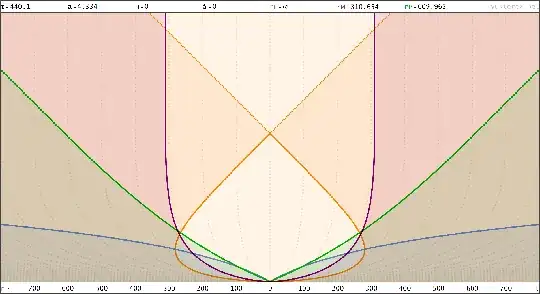
Below is a spacetime diagram of a static big bang universe, for example with the initial conditions $\rm \Omega_r=0.3, \ \Omega_m=1.1$ this requires $\Omega_{\Lambda}=0.00732259$ so that $\rm \dot{a}=\ddot{a}=0$ at $\rm a=4.33407$ (all the other higher time derivatives of $\rm a$ are also $0$ there):

static big bang universe

Hubble radius: blue, particle horizon: green, light cone: orange, maximal separation distance: purple, comoving worldlines: gray.

The light cone in the diagram above originates at the moment when the universe becomes static, so the gray dashed comoving worldlines become completely vertical in the upper half of the proper distance diagram.

Claudio Saspinski wrote: "My understanding is that Einstein had to add a cosmological constant (to keep a static universe) in the field equation exactly because a(t) could not be a constant."

That's right, since a hyperbolic universe with $\rm \Omega_k>0$ can't get static out of principle, while a closed universe with $\rm \Omega_k<0$ suffers a Big Crunch when $\Omega_{\Lambda}=0$, so the latter has to be the right positive amount in order to reach a static state or start static from the beginning.

Yukterez
  • 14,655