1

Consider a delayed choice quantum eraser:
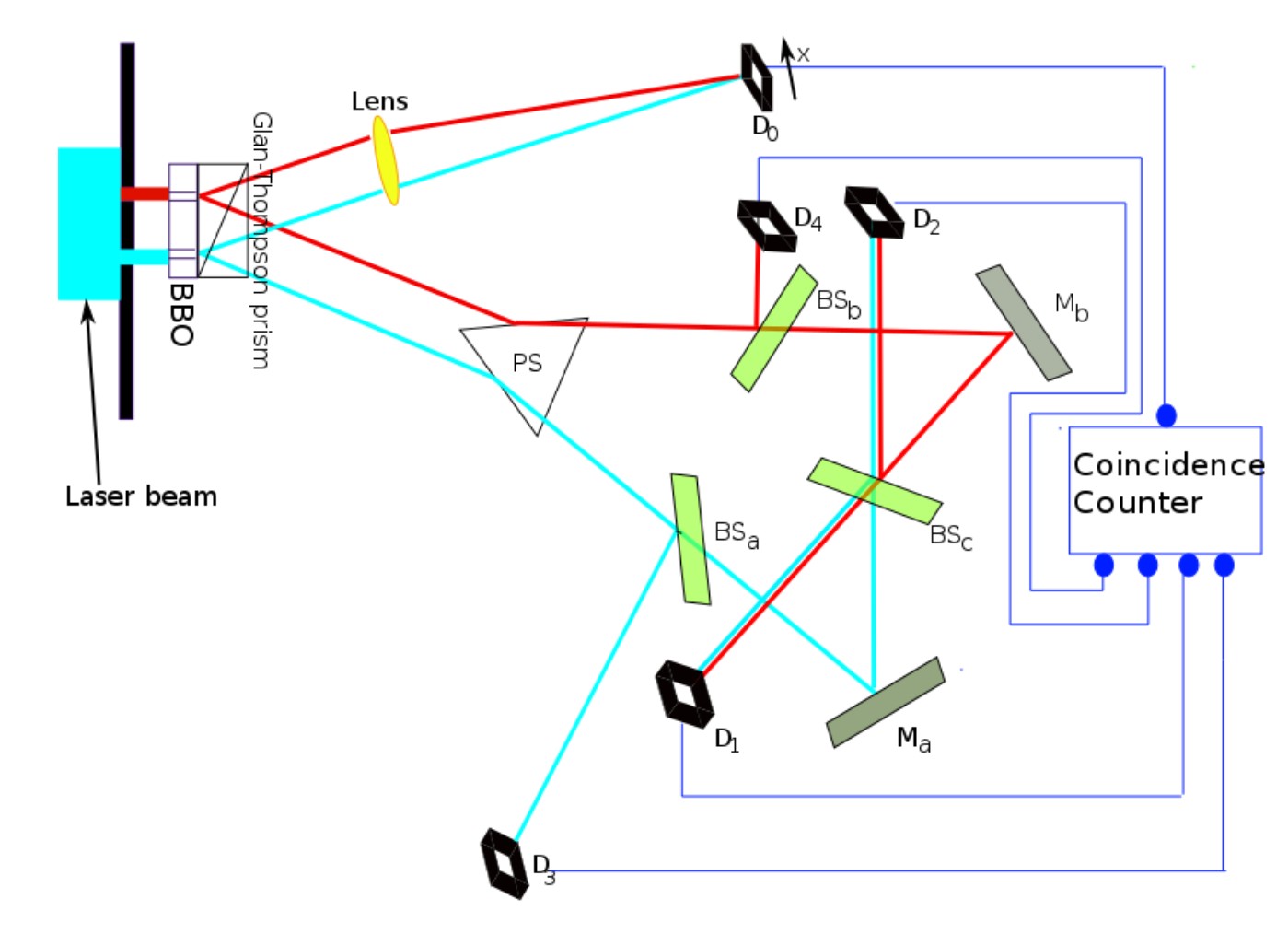
Delayed choice quantum eraser

There is an interference pattern at D1. There is an interference pattern at D2. There is no interference pattern at either D3 or D4.

I also understand there is no overall interference pattern (if you count all photons regardless of which detector has been hit), and the question is, why?

The total pattern would be a sum of patterns at D1, D2, D3 and D4. If there is no overall interference pattern, it means interference patterns at D1 and D2 cancel each other. Why does it happen?

The shape of an interference pattern is determined by the geometry and the wavelength, and both are the same at D1 and D2. So why are interference patterns at D1 and D2 different at all?

cuckoo
  • 979

2 Answers2

2

Only when two things contribute to exactly the same wave function can there be interference. Because the two paths for the traveling electrons are now entangled with the recording electrons, the left and right paths are distinguishable, so no interference pattern is seen as shown below;

enter image description here

-1

Of course, we are talking about coincidences with D0 in all cases (D1/D2/D3/D4). See https://arxiv.org/abs/quant-ph/9903047 for the underlying experiment by Kim et al.

See figures 3 and 4, which show the D1 and D2 outcomes. I would not say "D1 and D2 cancel each other" as you do.

The reason they are different (as you ask) is effectively like saying: "D1 shows a pattern for the left slit, D2 shows the pattern for the right slit". That is not technically accurate, but it captures the spirit. They are but essentially simply mirror images of each other - i.e. otherwise the same.

DrChinese
  • 2,593