2

I've seen several videos that claim that the Bullet Cluster is evidence for Dark Matter. The general idea is that the gas is trapped on one side of the collision and the light-bending "Dark Matter" appears to have passed through the collision without slowing down and forming a lense. What I don't understand is the conclusion: that Dark Matter is responsible for the resulting lensing effects.

How do they know it isn't supermassive black holes causing the lensing? Wouldn't black holes be effectively "collision-less" in that same scenario?

3 Answers3

6

Yes, the "dark matter" could be in the form of black holes. So long as they were distributed in the way that is inferred from the gravitational lensing effects. But not supermassive black holes.

In order for the black holes to be classed as "non-baryonic dark matter" they would have to be primordial black holes - formed before the epoch of nucleosynthesis in the first few minutes after the big bang. We know that "dark matter" must be predominantly non-baryonic - formed from material that did not participate in the formation of hydrogen, deuterium and helium. Black holes that formed later by the collapse of stars or by accreting "normal matter" would not fit the bill and would be classed as "baryonic dark matter".

However, the idea that the dark matter required in our universe is only in the form of primordial supermassive black holes is ruled out from other arguments and observations - e.g., the observation that dark matter appears to be distributed rather uniformly around visible galaxies and not in the form of relatively few supermassive dark objects. Current constraints suggest that if primordial black holes are to make up most of the dark matter then they must have masses either in the range $10^{14}-10^{20}$ kg or $10-100M_\odot$ (Carr & Kuhnel 2021).

ProfRob
  • 141,325
4

Here is the first figure from one of the original Bullet Cluster dark matter papers, Markevitch et al 2003. Figure 1 from Markevitch et al 2003. (a) Overlay of the weak lensing mass contours on the optical image of 1E0657–56. Dashed contours are negative (relative to an arbitrary zero level).
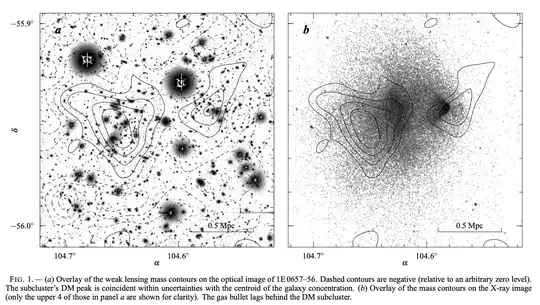
The subcluster’s dark matter peak is coincident within uncertainties with the centroid of the galaxy concentration. (b) Overlay of the mass contours on the X-ray image. The gas bullet lags behind the dark matter subcluster

The contours are the same in both panels and show the mass density of dark matter obtained from gravitational lensing. Notice how they form a continuous distribution of mass spanning mega-parsecs (Mpc). 1 parsec is about 3 light years, so the dark matter is spread out over millions of light years in size. For comparison, the radius of a 1 million solar mass black hole is about $10^9$ meters. That's $10^{-7}$ light years.

Panel (b) compares the dark matter distribution to the x-ray image. Regular matter, like gas, interacts with other regular matter causing it to lose energy. This is basically like friction or fluid viscosity. The interactions cause the gas to heat up to very high temperatures (converting mechanical kinetic energy to thermal energy) and emit x-rays (converting thermal energy to photons). The dark matter doesn't interact and doesn't lose energy this way. The dark matter halos pass through each other, with the regular matter lagging behind.

Everything still experiences gravity. To say the dark matter is non-interacting is to say that it doesn't experience electromagnetic or nuclear forces (or it only experiences them at a much, much weaker level than regular matter).

The Bullet Cluster in and of itself doesn't rule out dark baryonic matter or black holes. It is seen as a refutation of modified Newtonian dynamics (MOND). MOND explains galaxy rotation curves by modifying gravity. The dark matter hypothesis says there is extra mass in galaxies that does not emit any detectable electromagnetic radiation causing the observed rotation curves.

Only ~$10\%$ of the luminous matter in a galaxy cluster is observable in the optical with the remaining luminous mass observed in X-rays. If there were no actual dark matter and MOND were right, we would expect the microlensing region to align more with the X-ray emission since that's where most of the mass is (in this case the microlensing mass determination based on GR would be wrong).

If dark matter is real, then it is possible for the microlensing region to decouple from the X-ray emission under the right circumstances. The Bullet Cluster provides exactly the kind of situation where the microlensing mass is observed to move independently of the X-ray mass. This shows the microlensing is not just the result of the X-ray mass's (modified) gravity, but is real mass in the cluster.

Clowe et al (2003) is the original Bullet Cluster dark matter v. MOND paper. Notably they don't claim to fully refute MOND. They say that even if you assume MOND is correct, there still needs to be dark matter to explain the Bullet Cluster observations.

If we actually want to figure out what the dark microlensing mass is, we need to turn to other observations. @ProfRob discusses this in another answer.

Paul T.
  • 7,504
  • 23
  • 43
0

It is hard to imagine a supermassive black hole providing the Bullet Cluster its multiple characteristics predominantly the separation of gaseous and dark matter components. Multiple smaller objects are required in addition to the gaseous component. In this context, no machos have been observed down to near earth size to account for the dark matter component, but this does not negate the possibility of trillions of meter sized objects that in aggregate have near critical density(10^-29 g/cm^3) but are not observable (other than gravitationaly) due to their galactic size mean free path(no Tyndall affect). In the context of the Bullet Cluster, an extremely tenuous dark energy viscosity(10^-16 Poise) could differentially separate these objects from gas molecules by a Stokes' law differential size separation mechanism. At a much different scale, it would be like dropping marbles in oil. The larger marbles would fall faster and separate themselves from the smaller marbles.