3

As far as I know, inertial frame of reference are the ones where the all the three Newton's laws of motion hold. Having this definition we can then identify all such frames of reference which are inertial, if we have an inertial frame of reference, to begin with, to observe them by applying Newton's first law of motion i.e.,

  • If S is an inertial frame of reference then we can conclude that S' is also an inertial frame of reference if velocity of S' is uniform/constant with respect to S.

Now from these, we can define a non-inertial frame of reference as a frame of reference where laws of motion are not valid in their current form and need to be modified so that they can be used (such as introduction of Fictitious force).

Now the question:

  • Given a non-inertial frame of reference what is(are) the condition(s) required to affirm whether another frame of reference (being observed from the current non-inertial frame) is inertial or non-inertial?

I think a brief background to the question is required. I thought of this situation while considering the following case: suppose we are observing an observer (in space) from Earth, how may I claim that the the reference frame attached to that observer is inertial or not? Clearly earth is a non-inertial frame of reference, hence the question.

Qmechanic
  • 220,844

7 Answers7

3

You don’t need a second frame to determine if a frame is inertial. Simply compare the coordinate acceleration in the frame to the proper acceleration measured by momentarily co-moving accelerometers. If they match then the frame is inertial. If they do not match then the frame is non-inertial and the difference between the coordinate acceleration and the proper acceleration is a fictitious force.

Dale
  • 117,350
0

Given a non-inertial frame of reference what is(are) the condition(s) required to affirm whether another frame of reference (being observed from the current non-inertial frame) is inertial or non-inertial?

I think a brief background to the question is required. I thought of this situation while considering the following case: suppose we are observing an observer (in space) from Earth, how may I claim that the the reference frame attached to that observer is inertial or not? Clearly earth is a non-inertial frame of reference, hence the question.

I assume you can't go to the space observer's frame of reference, so you have to do it at a distance.

Motion is more generally composed of inertial motion (field forces) and non-inertial motion (contact forces). In your example, you are on the surface of Earth observing someone in space, so you have to separate the components.

When you are in deep-space (gravity negligible) either "standing still" or travelling with constant velocity, then you are clearly in an inertial frame. The same hapens when you are in free fall in a gravitational field (either in a parabolic trajectory over a planet's surface, or in orbit around a large mass). In both scenarios, you don't feel motion, you are weightless, because gravity is a field force and thus your accelerometers measure zero, and you are always oriented to the same direction in space, just as a gyroscope.

The inertial motion due to gravity must be measured by an external referential, say the distant stars.

Then, you have to know how much of your motion is non-inertial. Since you are being held in the surface of Earth by the normal force, then you can feel weight, because the normal force is a contact force, and thus you can measure the proper acceleration it causes using an accelerometer.

When you have determined how is your motion composed, measuring both your proper acceleration due to the normal force using accelerometers, and the coordinate acceleration due to gravity using relative position to distant stars, then you have to measure the motion of the observer in space relative to you.

Now the trick part: the observer in space motion's may also be composed by inertial and non-inertial movement, so you have to estimate what the gravity field looks like in the observer in space's position.

Once you have a) your motion decomposed into inertial and non-inertial components, b) the relative motion between you and the observer in space mapped in detail - so you know what their movement relative to the distant stars is, and c) an estimate of the gravity field around the space observer, that is, what are the geodesics in their surroundings, then you can d) subtract their inertial motion, and whatever motion is left is their non-inertial motion.

Note that this is very difficult to do in practice, not only beacuse the form of the gravitational field may be very complicated (many celestial objects, near and far, dust clouds, small but heavy meteorites, etc.), but because so many factors can cause the space observer's proper motion (small amounts of gases being expelled from it, thermal radiation emission and absorption, and even anisotropic radiation pressure - see the Pioneer anomaly). See, for example, the controversy surrounding the non-gravitational trajectory of the ʻOumuamua object.

Arc
  • 360
0

Tell the people in the frame you look at to go to different positions without relative motions and fixed wrt to the axes of their frame. Tell them to hold a mass. Then tell them to unleash the masses they hold. If the masses stay stationary wrt one another and the frame, the frame is inertial. If not, the frame is non-inertial.

0

As the OP has mentioned Newton's laws, I will not not use concepts of general relativity.

Besides the $3$ Newton's laws, there is also his force of gravity. So, if the planets including Earth are moving around the Sun, they are not inertial frames, they are accelerated by the gravity force. The Sun itself is not an inertial frame because it rotates around itself.

A good candidate at a first approximation (that considers the orbit of the Sun around the galaxy center as a second order effect) is a rocket that keeps the same position $(R,\theta,\phi)$ in a system of spherical polar coordinates with the Sun at center, and the fixed stars as angular coordinates reference. Or moving in a straight line in this frame.

The rocket should burn fuel to generate a force to balance the gravity attraction from the Sun (and other planets) at each location, so that the sum of forces are zero on it.

0

This is a variation of the answer by @Felicia.
(One can also attach accelerometers to the lab, as @Dale suggests.)


From my answer to How can one tell they are accelerating? ,
have them conduct an experiment as Ivey & Hume did:
If a ball that is dropped from the top of a stand
lands at the base of the stand, then the frame is inertial.

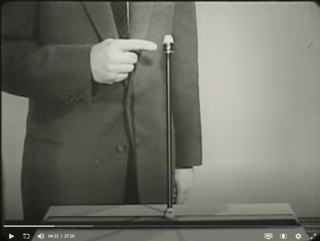
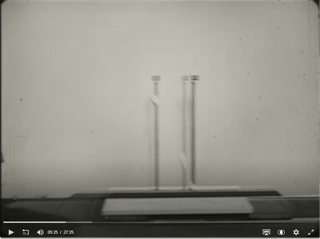
Here are a few frames (superimposed) from Ivey and Hume's Frames of Reference video https://archive.org/details/frames_of_reference

(You can probably find it on YouTube [with slightly different timestamps]. However, this archive.org URL should be more permanent than YouTube.)

  • At t=4m22s , this is a ball dropped from a cart at rest in the inertial-Lab frame. When released, there is no horizontal force on the ball, hence it has constant horizontal velocity in the Lab. It lands at the base of the stand.
    IveyHume-InertialAtRest-viewedInLab IveyHume-InertialInMotion-viewedInLab
    At t=5m25s , this is a ball dropped from a cart in uniform motion in the inertial-Lab frame. When released, there is no horizontal force on the ball, hence it has constant horizontal velocity. It lands at the base of the stand.... just like it was at rest-and-inertial.

From your non-inertial frame, you might find it difficult to write an expression for the trajectory of the falling ball... but what you want is the result... Does the ball end up at the base of the stand?

If you don't allow me to use gravity, do a variation where the projectile is sent across the room. Did the projectile end up at the end point of a segment tangent to its initial velocity?


For accelerated cart case,
continue to How can one tell they are accelerating? In that non-inertial case, the ball does not land at the base of the stand.

The full video treats the case of a rotating frame of reference and the Foucault pendulum.

robphy
  • 12,829
0

To confirm that another frame of reference $F$ is intertial while standing on Earth, take an accelerometer and point it in directions that shows one is accelerating, say with acceleration $\vec{a}$ (not explained by e.g. gravity). Measure the velocity of $F$ in that direction to confirm that it is accelerating with acceleration $-\vec{a}$. Turn the accelerometer in directions were it doesnt show acceleration. Check $Fs$ velocity in that direction to confirm that it is not accelerating.

-1

If you can move into the observer's frame, your own frame doesn't matter. You simply go to the other frame, assume the frame is inertial and calculate the acceleration of some body there with the laws of motion. Then you actually measure the acceleration in the observer's frame. If they match, then you can say that the reference frame is behaving inertially in that motion you investigated.

If you can't move into the observer's frame, you would need outside information. For instance, if there's someone there saying they are static in their own frame. Do this: Measure their acceleration as seen from your own frame, next you account for the effects of the acceleration of your own frame. If the static observer is still moving with some acceleration, then the outside frame is not inertial.

Klaus3
  • 482