This is a good question.
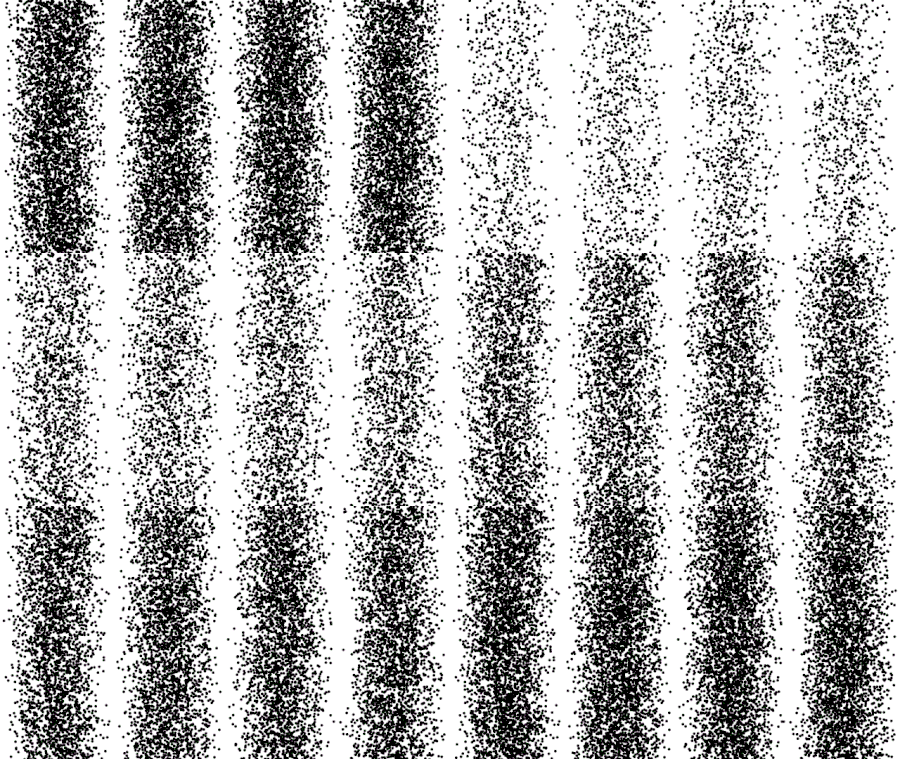
Wave-particle duality is a physical reality of quantum systems. Insofar as we can encapsulate this by a principle, we can 'understand' it (based on the results of experiments described in [1]) to be a consequence the (bizarre yet absolutely fundamental and unavoidable) assumption that particles do not follow paths, which is the physical content of the 'Heisenberg Uncertainty Principle'. This is the really incomprehensible thing about quantum mechanics.
This is the basis for the end of classical mechanics and the main motivating principle, along with the assumption of that classical mechanics still exists in some to-be-defined 'classical limit', for setting up the formalism of quantum mechanics that we find.
If we then agree to work with quantum mechanics, and if we agree (of course even some textbooks unbelievably actually disagree with this next thing) that the wave function of a single free particle of definite energy $E$ and definite momentum $\mathbf{p}$ is
$$\Psi(\mathbf{r},t) = A e^{- \frac{i}{\hbar} E t + i \frac{i}{\hbar} \mathbf{p} \cdot \mathbf{r}}$$
(this can be found by solving the free-particle Schrodinger equation, and assuming $A$ is a normalization constant, note using a normalization constant here might really puzzle people but of course it makes sense) then the 'wavelength' is the length of the vector $\vec{\lambda}$ in $\mathbf{r}+\vec{\lambda}$ such that the above wave repeats itself, i.e. $\vec{\lambda}$ should satisfy
$$e^{\frac{i}{\hbar} \mathbf{p} \cdot \vec{\lambda}} = 1 \ \ \to \ \ \frac{1}{\hbar} \mathbf{p} \cdot \vec{\lambda} = 2 \pi \ \ \to \ \ \lambda = \frac{2 \pi \hbar}{p} = \frac{h}{mv}. $$
So quantum mechanics (done properly) accounts for the 'de Broglie wavelength' that just makes no sense from a classical perspective. In other words, the Heisenberg Uncertainty Principle stated above coupled with the basic principles of quantum mechanics directly leads to the 'de Broglie wavelength'.
To be clear, the 'particles' are actually 'point particles', not 'waves' at least in any usual sense. If they were 'waves' in any usual sense then these waves would themselves have to be made up from degrees of freedom that themselves would just behave like particles so it would simply make no sense. It is absolutely fundamental to understand that they are point particles whose motion possesses wave-like properties (due to the bizarre non-existence of paths). The 'wave function' written above governs the probability distribution for the motion of a free point particle through space, it's wave-like properties capture the 'wave-like' properties of a particle which doesn't follow well-defined path as best we can.
If we invoke special relativity then one can further show that all particles absolutely must be 'point particles' and not miniature 'rigid bodies' (i.e. extended objects but with no new degrees of freedom which if it worked would bypass the problem with 'waves' and the extra degrees of freedom). While the 'rigid body' model fails because it contradicts special relativity, the obvious idea is to try to modify it to be in accordance with special relativity, i.e. a 'relativistic rigid body' if that makes sense.
Indeed a method does exist to bypass this issue: the idea is to embed a 'relativistic surface' into space-time. It's called (bosonic) 'string theory', and one can show such strings have no internal degrees of freedom only degrees of freedom orthogonal to the string in space-time (only if we use a 'sting' and not a higher surface called a 'brane'). Obviously this is still a work in progress, and at least on an experimental level so far not at all what wave-particle duality is about, so from the perspective of point particle physics, we must assume they are particles whose motion has wave-like properties.
On a mathematical level, over 90 years ago people proved (I wont check the precise earlier references) and Heisenberg placed in his book ([1], Appendix 11) the equivalence between the 'point particle' model of quantum mechanics, and the 'quantum field' model of quantum mechanics, explicitly referring to it as the mathematical counterpart to the physical notion of wave-particle duality. In more modern terms he just showed the equivalence of first and second quantization, which is unfortunately very commonly completely misunderstood with people often claiming something along the lines of 'everything is fundamentally just quantum fields'.
Indeed wikipedia says the following regarding wave-particle duality relevant to this:
Werner Heisenberg considered the question further. He saw the duality as present for all quantic entities, but not quite in the usual quantum mechanical account considered by Bohr. He saw it in what is called second quantization, which generates an entirely new concept of fields that exist in ordinary space-time, causality still being visualizable. https://en.wikipedia.org/wiki/Wave%E2%80%93particle_duality
References:
- Heisenberg, "The Physical Principles of Quantum Theory", 1st Ed. (1930).