11

We have an object with weight $D$ at a given location on table wit with four legs ($F_1$ to $F_4$). What is the force applied on each leg? (for simplicity, I'm just using the same labels $F$ and $D$ for both the location and the force)
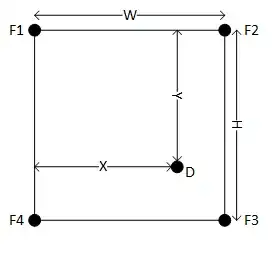
object on a table

$W$, $H$, $x$, $y$ and $D$ are given. To find the forces on each leg, as far as I remember, I have to consider two general equations: $\sum F=0$ and $\sum M=0$. So I have:

$$ F_1 + F_2 + F_3 + F_4 - D = 0 $$

Also, considering the moments round the point $F_1$:

$$ W(F_2+F_3) - xD = 0 $$ $$ H(F_3+F_4) - yD = 0 $$

But this just give me 3 equations! I missing one more equation and cannot figure it out.

Shapul
  • 133

3 Answers3

7

As you have noticed yourself, your system is simply underdetermined. In order to find a unique solution you need to add some extra constraints in addition to Newton's equations. Imagine a table with more than four legs: the more legs you add, the more unknown forces you have. But the number of equations does not change. If we instead remove a leg we find a unique static solution.

See also the Wikipedia page about statically indeterminate systems.

Olof
  • 2,257
  • 1
  • 18
  • 23
7

The simple answer is that you can't fully solve this problem--because as you note it is under-constrained--under the assumptions that are made when you first start doing statics (that objects are completely rigid).

The introduction of finite strains bring in additional relationships.

3

This looks like a simple linear blending problem. It is two-dimensional, but each dimension can be considered independently.

The more to the right the weight is, the larger the fraction of it carried by F2 and F3. Basically, the fraction of the weight carried by F2 and F3 is X/W. Put more mathematically:

   (F2 + F3) / (F1 + F2 + F3 + F4) = X / W

The same can be done for the Y direction.

This gets you 0-1 fractions for left/right and top/bottom, with left = 1-right, etc. Now multiply the fractions due to the X and Y ballance for each leg. For example, F3 = (X/W)(Y/H). You can write down the overall 0-1 fractions for each leg like this from inspection. Then to get the actual force instead of the fraction of the total, multiply each by the total weight, which it seems you are calling D. Therefore F3 = D(X/W)(Y/h), and the formula for the other legs follows similarly using the 1- rule.

Olin Lathrop
  • 13,084