9

My understanding is that in a double-slit experiment, quantum interference disappears if which-path information is available. How is available defined? Consider the following experiment:

SPDC is used to create an entangled pair of photons. The signal photon goes through a double-slit with a detector behind it. The idler photon hits the wall of the laboratory. Is which-path information available? After all, theoretically the information carried by the idler could be reconstructed from careful measurement of the wall's properties. In such a case is interference observed? How "available" must which-path information be?

user1247
  • 7,509

4 Answers4

11

This question actually has a very easy and rigorous answer. Having which-path information "available" is just a crude way of saying that the system is correlated with anything else. Usually, this is because the system has been decohered in whatever basis corresponds to the possible paths, which is usually position basis. In your case, the photon is actually never put into a coherent local superposition, and so interference will not be seen. Instead the SPDC process essentially creates a Bell state where one photon is thrown away. Skematically, the situation you describe is as follows. The splitting process is

$\vert S \rangle \otimes \vert I \rangle \to \frac{1}{\sqrt{2}} \Big [ \vert S_L \rangle \otimes \vert I_L \rangle + \vert S_R \rangle \otimes \vert I_R \rangle \Big ] = \vert \psi \rangle \qquad \qquad \qquad (1)$

where $S$ and $I$ stand for the signal and idle photons, respectively, and $L$ and $R$ stand for the left and right path. The reduced state of the signal photon is

$\rho^{(S)}=\mathrm{Tr}_I\Big[\vert \psi \rangle \langle \psi \vert \Big]$

(If you don't know what $\mathrm{Tr}$ means, or what a density matrix is, you absolutely must go learn about them. It doesn't take that long, and is crucial for understanding this question.) The measurement performed by the apparatus is essentially a measurement in the basis $\{ \vert \pm \rangle = \vert S_L \rangle \pm \vert S_R \rangle \} $. Here, getting a "plus" result in the laboratory means seeing the photon near a peak on the screen, and a "minus" result is seeing it in a trough.

You can check that measuring $\rho^{(S)}$ in the $\{ \vert \pm \rangle \}$ basis (or, in fact, any basis at all) gives equal probability of either outcome. This means no interference pattern, since photons are evenly spread over peaks and troughs. In particular, this is true no matter what happens to the idle photon; it could be carefully measured, or thrown away.

On the other hand, if you simply send the photon into a double slit experiment by sending it through a small hole and allowing the photon to enter either slit without being correlated with anything else, the evolution looks like

$\vert S \rangle \to \frac{1}{\sqrt{2}} \Big [ \vert S_L \rangle + \vert S_R \rangle \Big ] \quad \qquad \qquad \qquad \qquad \qquad \qquad \qquad \qquad (2)$

which doesn't involve a second photon that "knows" anything. In this case, a measurement in the $\{ \vert \pm \rangle \}$ basis gives "plus" with certainty (or near certainty), meaning we see an interference pattern because all (or most) of the photons only land at the peaks.

Finally, suppose we place a second particle like a spin-up electron in front of the right slit such that the electron's spin flips if and only if the photons brushes by it on the way through the right slit. In this case we'd get

$\frac{1}{\sqrt{2}} \Big [ \vert S_L \rangle + \vert S_R \rangle \Big ] \otimes \vert e_\uparrow \rangle \to \frac{1}{\sqrt{2}} \Big [ \vert S_L \rangle \otimes \vert e_\uparrow \rangle + \vert S_R \rangle \otimes \vert e_\downarrow \rangle \Big ] \qquad \qquad (3)$

Now, although nothing has really happened to the signal photon as it passed through the right slit--it doesn't, say, get slowed down or deflected--the electron now knows where the photon is. In fact, this state is identical to the first one we considered except with the electron in place of the idle photon. If we make a measurement on the signal photon, we now get either outcome with equal likelihood, meaning the interference pattern is lost.

The process of the electron getting entangled with photon is known as decoherence. (Note that we only use that word when the electron is lost, like it usually is. If the electron was still accessible and could potentially be brought back to interact again with the photon, we'd just say they had become entangled.) Decoherence is the key process, and plays a fundamental role in understanding how "classicality" arises in a fundamentally quantum world.


Edit:

Make sure not to confuse two possible situations. The first is where the momenta of the idle and signal photon are correlated, and the slits are positioned to simply select for one of two possible outcomes, corresponding to equation (1) above:
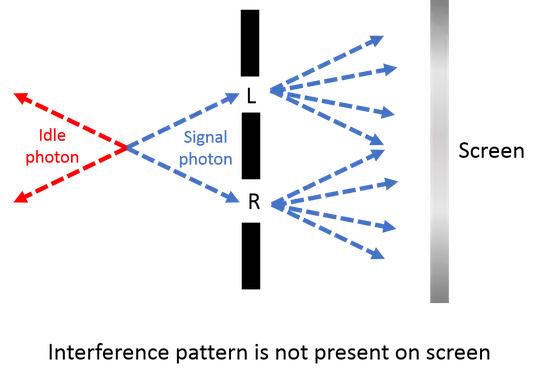
firstcase

The second is where the signal photon's spread over $L$ and $R$ is not caused by an initial event correlating it with idle photon, but simply by its own coherent spreading when it is restricted to pass through a small hole, corresponding to equation (2):
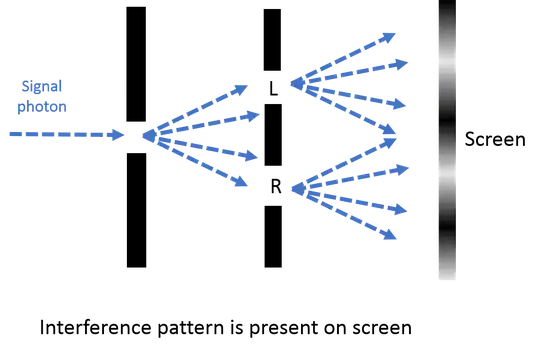
secondcase

Note here that there is no violations of conservations of momentum, a subtle (for beginners) consequences of the infinite dimensional aspect of the photon's Hilbert space. (The fact that the two-slit experiment is the canonical example for introducing quantum wierdness is unfortunate because of these complications.) When the photon is confined to a small initial slit, it necessarily has a wide transverse momentum spread.

It might be helpful to concatenate these two cases:
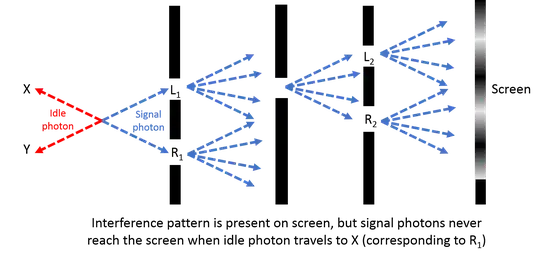
enter image description here

Here, the idle photon is initially entangled with the signal photon, but the wall with the single slit destroys the signal photon for the $X/R_1$ outcome. When $Y/L_1$ happens, the signal photon can now be sent through 2 slits to produce and interference pattern. The idle photon's direction $X$ vs. $Y$ was correlated with the signal photon's $L_1$ vs. $R_1$, but it is never correlated with $L_2$ vs. $R_2$.

Jess Riedel
  • 3,764
2

So, to be clear, my understanding of your setup is that you are doing SPDC in a noncollinear geometry, so you get photons entangled in transverse momentum, and you basically want to get the momentum of one photon from the other, by studying the wall.

To get interference, the momentum change must be indistinguishable in principle, not just practically. How could this happen? Well, the wall itself is also a quantum object, so if its two possible momenta from the photon are both within the uncertainty of its total momentum, it is not possible to distinguish the two cases.

In the case of this setup, really what you are suggesting is a quantum eraser experiment, in a way. While both photons exist, which-path information does too, but if the idler is absorbed in such a way that this information is no longer present in the object it interacted with, interference is re-established- at least in the formalism. Whether the wall preserves this information or not depends on its specific properties, but generically it would not. Especially once you consider the effects of finite temperature to redistribute the photon's energy and momentum across the atoms in the wall, such that each one only gets an incredibly tiny change to its state that is not distinguishable from its other interactions.

To compare this with a typical quantum eraser experiment, look here for example. Notice that they do their erasing with polarizers, but you can think of the polarizer itself as like a wall, when it is set at the correct angle to erase. After all, when light is changed by a polarizer it must also leave some tiny effect on the polarizer itself, but the recovery of interference fringes in their experiment (and many others) demonstrates that for a macroscopic object, any energy that's not deposited in a specially sensitive channel (like, say, a avalanche photodiode reaction) will in general erase quantum information.

(edit: this analysis is incorrect; see comments)

edit2:

from the comments:

1) Every resource I can find (see wiki:en.wikipedia.org/wiki/Quantum_decoherence, for >example) disagrees with you, seeming to require interaction with the environment in order >to induce decoherence. And 2) If what you say were true then no photon would ever show >interference in a double slit experiment, since it is surely entangled in some way with a >particle in the past. It seems as though you are saying that the schrod. eq. does not apply >to entangled particles (wave funct diffusion -> interference)?

There is no inconsistency between what I am saying and what they are, but I have to be very careful to be clear about what I mean by 'decoherence,' and by 'environment.'

When you have two particles that are entangled, one can describe the system in terms of the possible measurements on the two objects together, or on one or the other individually. Looking at both objects together is more 'complete,' in the sense that it gives you all the information of individual measurements and the correlations as well, but on the other hand sometimes, like in the setup you've given, one of the particles is just being thrown away and you don't want to have to consider it.

Now, if you only have access to one of the objects, it turns out that object cannot be described by its own quantum state. Rather, you need to use the language of density matrices. So in this sense, you are right- the Schroedinger Equation is actually no longer true (but a slight generalization still holds). In the case you are describing, the density matrix for a single photon corresponds to a fully decohered mixture of traveling through the right and left slits.

To reconcile this with the other descriptions you've read, the key idea is to understand that decoherence is, in some sense, arbitrary. To get coherent effects, you need to have access to every part of the system that is entangled together, so if you can't do that you throw your hands up and say that it is decoherent. By doing this, you are saying that the system you are studying is entangled with the environment, with the environment simply defined as everything you aren't measuring. So effectively, when you throw away the second photon you have defined it as part of the environment, and you can still call it environmentally-based decoherence if you like.

So that brings us to your last, and very good, question- how is everything not entangled and decohered all the time? The short answer is that in the structure of quantum mechanics measuring something destroys all entanglement and acts as a sort of 'reset' on the state, after which you can prepare the object however you like. This is one of those issues that can be more and less obscure depending on how you interpret quantum mechanical measurement, but all this is really saying is that if you know an isolated object's initial conditions, of course you must be able to completely figure out what happens to it.

As far as references go, the most direct I've ever seen this point made is actually in the field of quantum computing. In that context the connection between decoherence and entanglement is called the 'principle of implicit measurement,' and it is stated as follows: if you throw away one part of your system, the effects are the same as if you had measured the properties of that part. Although it might not be obvious, this is identical to what I said above in terms of density matrices- and actually, in this wording it makes it extremely clear that you won't get interference in your second photon. You can find this in the Nielsen and Chuang book on Quantum Information, or restated in many different sets of lecture notes on google.

Rococo
  • 8,027
0

After all, theoretically the information carried by the idler could be reconstructed from careful measurement of the wall's properties.

This may not always be true if we take into account limit set by uncertainty principle. Such a comment would require knowledge about wall's properties.

If you can reconstruct the information to a degree of accuracy that tells you which slit the signal photon went through, then you will see no interference pattern.

Kamal
  • 308
-4

Yes, interference will be observed, (if you repeat with many photon pairs). For one single pair, you must remember that the photons are waves and spread out and take many paths (through all space and all time, if you believe Feynman). Also through both slits. Then "God throws the dice" and picks one tiny spot for each photon to land. So you really don't know which way the photon went for either photon, you only know where it ended up.

Jim Graber
  • 5,817