2

I want to start off by saying that I've looked around for other explanations, but I've not really found any satisfying ones. My question is basically the whole "Why can anything move at all?" question, with a little twist. Refer to this picture:
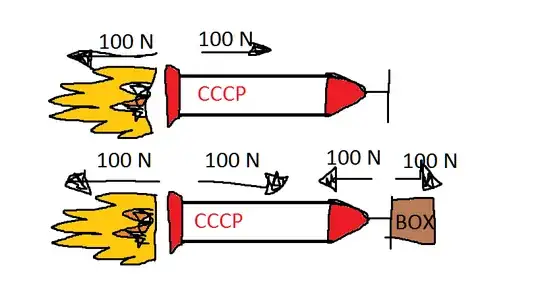
Now I understand that opposite forces act on different objects, so in the top one, the rocket would have a net force of a 100 N to the right, and accelerate, as per Newton's Second Law. However, in the bottom example, wouldn't the box push back on the rocket, equal and opposite, as the rocket pushes on the box, therefore cancelling the forward push from the exhaust, making the rocket not move at all, whilst the box gets a net force of a 100 N?

This isn't true obviously, but why not? Also, in this earlier Phys.SE post there is a great answer depicting a finger and a matchbox. Now this post is very related to mine. I'm wondering why in that picture, the force of the finger pushing on the matches doesn't equal the force of the muscles pushing forwards in the finger? Surely when I'm having a force pushing the finger forwards, that same force applies to the matches?

Peatherfed
  • 239
  • 1
  • 4
  • 9

4 Answers4

7

I'm not sure where that picture is coming from, but it's misleading at best and here's why.

Let's say that the rocket expels some stuff (like the flaming gases in the picture), then the force of the rocket on that stuff will be $-F$, say. By Newton's third law, the force of that stuff on the rocket will be $F$. Now let's consider the system consisting of the rocket plus the box. The net external force on this combined system is $F$ because there is nothing external to the system exerting a force on either the rocket or the box besides the gases. Assuming the rocket and the box are in rigid contact, the acceleration of each object equals the acceleration of the whole system which is given by Newton's second law as $$ a = \frac{F}{m_\mathrm{rocket} + m_\mathrm{box}} $$ Now consider the system consisting of only the box. The only external force on this system is the force $f$ of the rocket on the box, so that acceleration of the box must also satisfy $$ a = \frac{f}{m_\mathrm{box}} $$ Combining these results gives $$ f = \frac{m_\mathrm{box}}{m_\mathrm{rocket}+m_\mathrm{box}}F $$ and therefore $$ f < F $$ In other words, the contact force between the rocket and the box is less than the contact force between the gaseous exhaust and the rocket!

joshphysics
  • 58,991
1

The problem is you're assuming the box has the ABILITY to push back with equal and opposite force. Newton's 3rd Law only applies when both objects are CAPABLE of pushing back with the same force. In your box example, Newton's Second law actually comes into effect: The force the rocket exerts cannot be balanced by the box (friction, gravity, etc.), so you're left with an unbalanced force to the right. This means both objects will move to the right.

Daniel
  • 21
1

In my answer, I will stick to the diagram: the box is capable of applying 100N of force leftward. From the start:

(1) Ignition, Blast off: 100N of thrust accelerates rocket to the right.

(2) Rocket collides with box of unknown mass--which is ok, because its mass does not matter.

(3) Box now applies 100N of "box-force" to the left, balancing the 100N of thrust to the right:

(4) All acceleration stops, but velocity does not.

The question is "does the rocket not move at all". It moves, but no longer accelerates, as the net external force is 0N--so it cruises along at the velocity of 1st-box-contact.

Now if this were a physically sensible problem, one would just place the box AT THE BACK OF THE ROCKET, for an incredible specific impulse ($I_{sp}$).

JEB
  • 42,131
1

Look at the extremes (boundries). Anchor the box to the earth. Now the rocket and box go nowhere, because the box applies an equal and opposite force to the exhaust. Now make the box very tiny. the acceleration is a=F/M, where M=the rocket mass. Now make the box 1/10th the rocket. then a=F/(M+m). the acceleration slows down as the mass (m) of the box increases. The Force applied by the rocket exhaust has not changed. Only the "collective" mass of the rocket and box has changed.