7

(a) When there is a red or blue shift, is there an actual change in the energy of the photons or not?

(b) If there are two observers, one moving toward the light source and one away from it, they would see different red/blue shifts of the same set of photons from the same source, so that gives me a clue that actually the energy of the batch of photons is not changing, this is just some apparent effect that we are seeing. Then how can we say for both observers that the energy of the photons is proportional to the frequency? (the frequency observed by both observers is different, but it is the same batch of photons from the same light source presumably having the same energy)

(c) Assuming light is emitted by a bandgap transition, and the emitted photons have energy equal to the bandgap, then intuitively speaking, why does the motion of the emitter alter that energy?

I can understand how a number of cycles of waves can get compressed or expanded into a smaller or larger space depending on the motion of the emitter and hence change the wavelength. I can also understand how, if a gun is firing a bullet, and the gun is mounted on a fast-moving train, then the velocity and KE of the bullet will change as a result.

However, the photons travel at fixed velocity, and being massless, have no KE resulting from mass. So how is it possible that the physical motion of the emitter "relative to the observer" translates into a different energy of the photons than the bandgap energy from which they were emitted?

(d) If it is the observer that is accelerating towards the light source (e.g. the observer is in an accelerating rocket ship), then why would the energy of the distant photons change or why would the observer see a continuous change in red/blue shift?

2 Answers2

3

You ask why it is that the energy of the photon/wave packet is not the same in different frames of reference. I cannot offer a good explanation for the why but I think the following might "fix" the intuition where the question seems to originate.

Imagine an object just standing there in vacuum. Its energy is zero. But what would another observer (moving with constant velocity with respect to it) think its energy is? Well, not zero. The situation of a photon (i.e., a massless object which is not just standing there) is not the same, sure, but still the same question applies to both situations: Why would its energy be the same in reference frames moving at different velocities anyway? It simply would not.

I'll speculate that perhaps you are thinking "Energy is a conserved quantity; it must be the same." If that is the case, you must remember that implicit or explicit in such statements of invariance there is a transformation in mind. The transformation relevant to your question is the one that converts quantities from one (inertial) observer's reference frame to another's. Namely the Lorentz transformation. And energy of a particle (or the sum of energies of a bunch of particles) does not remain the same under this transformation. A quantity made out of both the energy and the momentum does, but this is perhaps not the place to dig into that.

If you would still appreciate an itemized answer, in light of the discussion above:

(a) There is an actual change in the energy of the photons.

(b) The energy of the batch of photons is changing. The intuition you voice in your parenthetical remark about the same batch of photons having the same energy is flawed. That's how intuition is sometimes.

(c) I would avoid the bullet analogy because the addition of velocities there does not apply to light at all. So it would only increase confusion. However your contemplations about the wavelength getting stretched or compressed are quite well-placed. In your band-gap transition example (which is a good one), it's not so much the motion of the emitter that affects the energy of the emitted photon (because the emitter is stationary according to its own reference frame!), rather it's the motion of an observer relative to it. As you pointed out, the wavelength of the oscillation will be different in that observer's frame. (This is true even for slow waves, not just photons, but the relation of the new wavelength to the old one is a bit more sophisticated in the latter case.)

(d) I'm not sure I understand this one. But perhaps once it fixes itself once you are not worried about the energy of a photon being different in reference frames with different velocities.

Cem Yolcu
  • 106
1

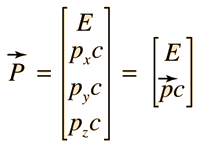
The photon is a relativistic elementary particle and is described by a four vector:

fourv

four vector

The length of this 4-vector is the rest energy of the particle. The invariance is associated with the fact that the rest mass is the same in any inertial frame of reference.

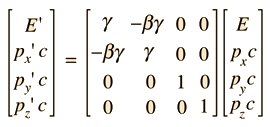
E is the total energy, of which the kinetic part is the one carrid by the momentum vector. The only invariants in frame changes is the mass, the vector itself changes according to the Lorentz transformation

lorenz

which depends on the velocity. So the mass is the only invariant to velocity changes, the momentum vector changes to p', and for the photon this means that the energy changes , according to the equation for the mass.

anna v
  • 236,935