update: The following have been found in Neutron Halo - Recent Experimental Progress at RIBF, Vol. 8, NO. 5 of the AAPPS Bulletin
- Observation of a Large Reaction Cross Section in the Drip-Line Nucleus 22C K. Tanaka et al. 2010 Phys. Rev. Lett. 104, 062701
- Interaction cross section study of the two-neutron halo nucleus 22C Y. Togano et al. 2016 Phys. Lett. B 761, 10 October 2016, Pages 412-418
- One- and two-neutron removal reactions from the most neutron-rich carbon isotopes N. Kobayashi et al. 2012 Phys. Rev. C 86, 054604 also in arXiv
The AAPPS Bulletin explains how the momentum distribution of 20C + 2n breakup is additional evidence of a 2 neutron halo (along with the small 2 neutron separation energy of only 0.14 MeV) but I can not follow the argument.
Halo nuclei are generally very light nuclei with a significant neutron excess. These isotopes usually decay in seconds down to milliseconds, and so are often observed as individual ions in motion. Most of the data are scattering and reaction cross-sections calculated from radioactive beam on target experiments. These isotopes are at the extreme limits of particle stability near the "neutron drip line" and the binding energy of the last one or two neutrons is usually very small compared to most nucleons.
According to the Phys.org article Experiments reveal a neutron halo around neutron-rich magnesium nuclei:
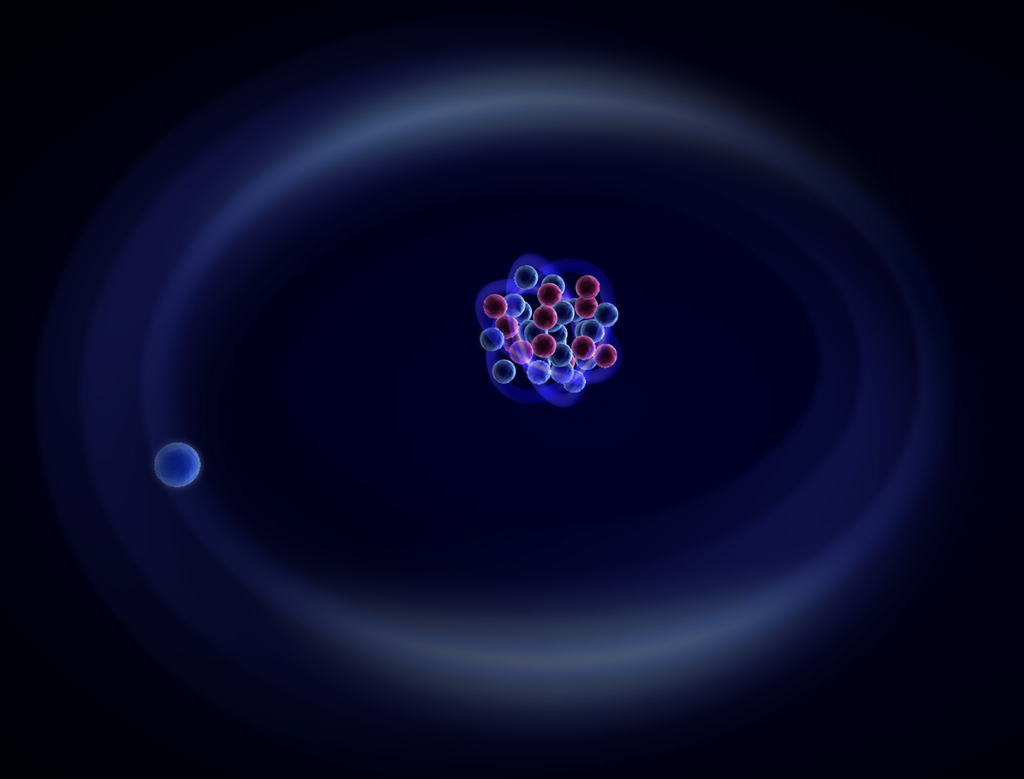
Neutron halos are a dilute cloud of neutrons that surround the more tightly packed neutrons and protons found at the center of a nucleus.
The article also says:
The researchers used RIKEN's Radioactive Isotope Beam Factory to produce nuclei of magnesium-37, consisting of 25 neutrons and 12 protons. To examine its properties, the researchers observed what happened when these nuclei were bombarded against a lead target. "We found that the magnesium-37 nuclei broke up easily into a magnesium-36 core and a single neutron," says Kobayashi. "Thus, we concluded that magnesium-37 has a neutron halo." (emphasis added)
Lead target nuclei are highly charged and this breakup may be caused by coulomb excitation sufficient to liberate the weakly bound neutron. Having a large reaction cross-section alone doesn't necessarily mean by itself that the magnesium-37 nuclei have a large physical cross-section or a large "halo". I understand that it might suggest the neutron may have a slightly larger wave function than other nucleons, but with a short-range nuclear potential, that should not be very much.
Have these halo's ever been demonstrated in non-nuclear reaction experiments, possibly with atoms at rest? Is there something more than "they break easily"?
below: from Phys.org.