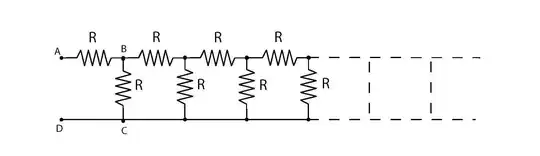
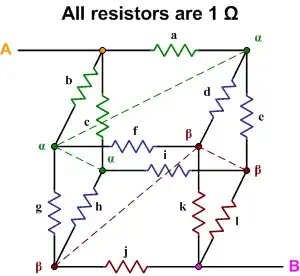
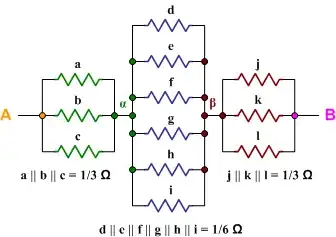
Lately, I've been reading about techniques to reduce networks and find their equivalent resistance/capacitance. While doing this, I came across the cube resistance problem and many other problems (eg. resistors on tetrahedron etc.), where the authors have argued that certain points on the figure have the same potential. But, none of them have explained a procedure which would allow one to use this technique for other problems. So I've two questions:
Does the figure need to be symmetrical in some manner if one has to use this technique?
How should one go about finding points with the same potential?
I've tried a couple of things: Suppose that we were required to find the equivalent resistance across the main diagonal of a cube. Then usually I would distribute the currents and look for branches carrying the same current. From this, I would try to deduce the points having the same potential. But of course, this technique hasn't worked so any hints or suggestions will be valuable.