28

Why is reflected light polarised?

I have learnt about Brewster's angle, and how at a particular angle all light reflected is polarised, but do not understand why. Is this something that could be explained to a guy that doesn't have a Ph.D in physics?

3 Answers3

13

The following diagram may be helpful:

enter image description here

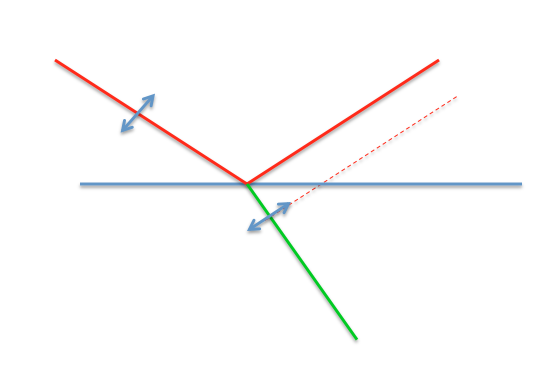
If you have an incident ray that is polarized with the E field up and down (in the plane containing the incident ray and the normal to the surface), then when that ray is refracted, it contains a component of electric field that is perpendicular to the refracted ray (and still in the same plane).

The reflection is actually caused by the motion of electrons in the medium. Now you can see that the electrons, which move along the direction of the E vector, are moving parallel to the direction of the reflected beam. An electrical dipole that is oscillating can send a wave in all directions - except the direction it is pointing (if you think about it, looking at the dipole "end-on" you don't see it moving: if it doesn't seem to be moving, it shouldn't be seen to be radiating towards you...). This entire analysis is only for the E field with the polarization drawn: if the incident light contains a component of E field perpendicular to the sketch (in and out of the page), that component will be able to radiate along the reflected direction from inside the dielectric.

So there it is - for this very special orientation, the reflected light must be fully polarized. If you do the math carefully (see Fresnel's equations), you will see that you will have some polarization at any angle - again, because the amount of polarization in the reflected light depends on the ability of the dipoles in the material to excite a reflected wave. The Brewster angle is a special case that gives “pure” polarization; at other angles, there will be partial polarization. Incidentally this is why polarized sunglasses help reduce “glare” - if the majority of surfaces you look at are near-horizontal (for example, a body of water), then the polarization of the reflected light will be mostly horizontal; and since polarizing sunglasses only allow vertically polarized light through, reflections are reduced.

Floris
  • 119,981
1

Answer to second part of question:

Is this something that could be explained to a guy doesn't have a Ph.D in physics?

Yes, it can be explained. I study in same class as you. I understood it in my third attempt.

Answer to first part.

Case at 90° enter image description here
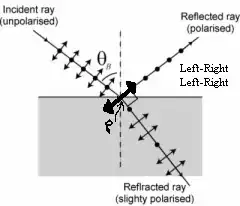
Consider medium particle is moving along direction indicated in figure. Let's call it LR LR.

You can imagine when particle vibrate along LR , it emits light in all directions except along LR. So, there is no component of light along LR. So, in reflected light no LR component is present.
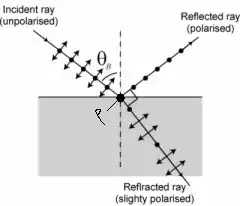
enter image description here Consider medium particle at P moving Up down Up down (out of plane of screen) It emits light in all directions, except at U D. So, Reflected light has component along plane of light.

But using Huygens principle, you see light can actually move in two ways. It can either reflect back at $\theta$ angle or refract to medium.

So, From combined effect of two, It can hence be said reflected light is polarized, as it has only U D component.

rob
  • 96,301
Anubhav Goel
  • 2,130
0

First, it is easiest to understand that light is changing field strengths in the electric and magnetic fields. If you move an electron other electrons will experience a change in the electric and magnetic field depending on the direction of movement and rate of movement. If you move that electron back and forth 600 trillion times a second, then other electrons will experience the electromagnetic field strength change 600 trillion times a second. This will cause the other electron to move back and forth at 600 trillion times a second. If this electron is in a molecule of pigment in your eye, a series of chemical reactions occur leading you to experience "blue."

If that other electron in in a molecule of silver in a mirror, then that electron will oscillate 600 trillion times a second, and it will create fluctuations in the electromagnetic field which other electrons will feel.

A reflection of light is caused by a wave front inducing an oscillation in a charged particle which then causes a new wavefront to form. In a reflective surface, the valence electrons are the charged particles that absorb those incident wavefronts. Atomic electrons have more freedom to move parallel to the material’s surface, especially if they are electrons in the conductive band of a metal like silver.

For the electron to move perpendicular to the surface of the material, the electron would have to move towards and away from the atomic nucleus. This movement is restricted to particular quanta determined by the electron orbitals the electron can transition into and out of.

So, wave components oscillating parallel with the surface of the material can induce continuous movement in the valence electrons of the material’s surface while waves components perpendicular is limited to electron shell configurations.

Digcoal
  • 177