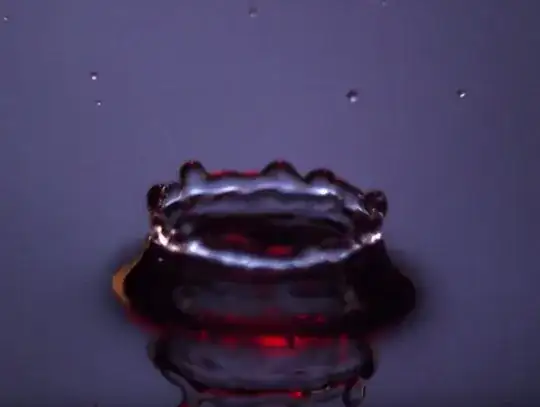
Is this phenomenon (crown shape) studied and described already?
Wetzel (1987) describes and tries modeling the splash process, including the crown. (There's a link to the PDF.)
A reference to it may be found on p. 208 of Surface Waves and Fluxes, Volume II — Remote Sensing, Editors: Geernaert, G.L., Plant, W.J. (Eds.). (Google might show you the preview.)
Crown-forming instability phenomena in the drop splash problem,
Rouslan Krechetnikov, George M. Homsy, 2009 (warning: pdf):
With the help of a set of experiments and new theoretical un- derstanding we were able to gain new insights into the nature of the instability responsible for the crown spike formation, as well as into the peculiarities of the crown evolution. In particular, we discovered that there are three major types of crowns — axisym- metric, regular, and irregular — and their selection is done at the very early stages of ejecta formation. Through estimates of growth rates and our kinematic measurements, the Richtmyer–Meshkov instability mechanism is found to play a dominant role at short times. The crown dynamics also exhibits a nontrivial bifurcation behavior, which includes frustration and irregular crown phenom- ena.
The above observations require new theoretical advances both at the linear and nonlinear levels of description in order to achieve a complete fundamental understanding of the crown formation and a quantitative comparison with experiments.
Additional information from an incomplete review of publications
This phenomenon is very known and still receives attention, as can be seen from the number of recent publications (see below for an incomplete list).
It was first photographed and described in 1908 by A. M. Worthington in his work A study of splashes.
The dynamics and relevant physics is clear and checked experimentally. The important elements have been identified and used to clasify the different forms of the phenomenon. For a short covering see this PSE answer or this paper that also tries to identify different regimes. That last paper shows that the "crown shape" is formed in the initial state of the collision and that it is at this moment that its features are determined, and hints on the origin being the Richtmyer-Meshkov instability.
A later paper shows that the phenomenon has several elements in agreement with calculated values from a model based on the Rayleigh-Plateau instability.
Finally, after a chase over recently published articles, however an incomplete and inexhaustive one, I have not find a consensus on the origin of the phenomenon, neither a theoretical model that explains it. Below there are some of the articles found:
Origin of ejecta in the water impact problem
Krechetnikov, R. 2014
Physics of Fluids
Numerical analysis of droplet impact onto liquid film
Shetabivash, H., Ommi, F., Heidarinejad, G. 2014
Physics of Fluids
Turbulent mixing driven by spherical implosions. Part 1. Flow description and mixing-layer growth
Lombardini, M., Pullin, D.I., Meiron, D.I. 2014
Journal of Fluid Mechanics
Stability on time-dependent domains
Knobloch, E., Krechetnikov, R. 2014
Journal of Nonlinear Science
Splash wave and crown breakup after disc impact on a liquid surface
Peters, I.R., Van Der Meer, D., Gordillo, J.M. 2013
Journal of Fluid Mechanics