24

As I understand it, electromagnetic waves have two components which are the result of each other, i.e., when a moving electric charge creates a changing magnetic field at point X then a changing electric field is created at point Y and this repeating process is what creates EM waves, so therefore, it requires no medium. Is my understanding correct?

One thing that I'm surprised to know is that light is also called an electromagnetic wave.

Does this include light of any kind, for example: light from a bulb, a tube, and also from the Sun? How do they contain electric and magnetic fields?

Qmechanic
  • 220,844
Ryan
  • 493

5 Answers5

18

Well, I would say the electromagnetic field is the medium.

For like the medium water oscillates when a water wave is observable after throwing a stone, so the electromagnetic field oscillates when excited by an antenna, say. If nothing oscillates there are no waves, neither in water nor in the electromagnetic field.

The medium disappears only when one thinks of an electromagnetic field as being nothing, only a vacuum. But this liberal view of the vacuum is quite different from the view of the vacuum in QED, the accepted theory of electromagnetic fields. There the vacuum state doesn't possess an electromagnetic field. More precisely, its expectation value - i.e., what is observable about it - is identically zero.

10

Yes you are completely right, but it took an intellectual revolution for physicists to realise that it made sense to have a wave that wasn't the motion or jiggling of some physical medium, a wave that could exist equally well in empty space.

All light is electromagnetic radiation. But to ask « How do they contain ... » is a little vague or philosophical. The correct answer is, the light is the field.

By the way, there isn't really a difference between the electric field and the magnetic field, they jointly compose one electro-magnetic field, and this one field cannot really be divided into two separate parts, one electric, the other magnetic, because two different observers who are moving in different directions would divide the same field differently, what one called electric, the other observer would call magnetic, showing that the division into two parts is somewhat artificial.

Finally, to answer perhaps what you really meant, how does the light bulb or whatever contain the field, the answer is it doesn't exactly at first, but turning on the current of electricity that flows through the filament produces motions in the electrons in the atoms in the filament at just the right speeds so that that motion of the electricity in the atoms generates a magnetic field and that starts the whole process. In its fundamental principle, it is the same as with a radio antenna, but the frequency of the motion is different so the electro-magnetic field produced is at a radio frequency instead of a light frequency, and there are other differences of detail also. I will not explain about how atoms emit photons since that, in a way, is already contained in what I said, I just said it in the wave picture of classical electromagnetic theory instead of in quantum terms.

4

Electricity and magnetism came together in the successfull mathematical model of Maxwell's equations. Before that, they were modelled as separate phenomena . These equations, classical electrodynamics, were very successful and have led to the technological civilization we are enjoying at present.

With the studies of the microscopic framework of atoms and molecules and particles, the theory had to be quantized , and it is called quantum electrodynamics. The two frameworks for describing electromagnetic effects, are consistent, the classical description emerging smoothly from the quantum mechanical.

Your question is answered by Arnold Neumaier within the quantum framework.

Here I want to address electromagnetic radiation within the classical electrodynamics framework.

Maxwell's equations are differential equations and their solutions for the electric and magnetic fields also give a wave solution.
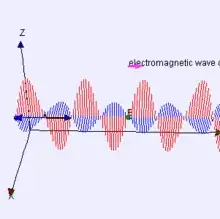
EMrad

Electromagnetic waves can be imagined as a self-propagating transverse oscillating wave of electric and magnetic fields. This 3D animation shows a plane linearly polarized wave propagating from left to right.

Note that the electric and magnetic fields in such a wave are in-phase with each other, reaching minima and maxima together so , even though you are correct that changing electric fields generate changing magnetic fields, and vice verso, the organization of the wave is not causal. The cause is the source and after the wave leaves the source the correlations/phases are fixed depending on the type of wave. It is interesting to read the history of electricity and magnetism .

Working on the problem further, Maxwell showed that the equations predict the existence of waves of oscillating electric and magnetic fields that travel through empty space at a speed that could be predicted from simple electrical experiments; using the data available at the time, Maxwell obtained a velocity of 310,740,000 m/s. In his 1864 paper A Dynamical Theory of the Electromagnetic Field, Maxwell wrote, The agreement of the results seems to show that light and magnetism are affections of the same substance, and that light is an electromagnetic disturbance propagated through the field according to electromagnetic laws.

At the time, even though the solutions of the Maxwell equations did not require a medium for the light, physicists used with waves from acoustic to water ones, proposed that the waves of light moved on a medium called luminiferous aether. Experimental data , the Michelson Morley experiment, showed that the aether did not exist. So it is an experimental fact that light does not need a medium to propagate.

One thing that I'm surprised to know is that light is also called an electromagnetic wave.

Does this include light of any kind, for example: light from a bulb, a tube, and also from the Sun?

Yes light of any source as visible and also radiation that is invisible to the human eye, as xrays, gammas, infrared etc .

How do they contain electric and magnetic fields?

The mathematical description contains an electric and magnetic field because Maxwell's equations are expressed in terms of electric and magnetic fields , and thus the solutions that have been identified with light and all the rest of radiations, also have the electric and magnetic fields in the functions.

anna v
  • 236,935
0

A really nice and easily understandable (no physics required) analogy is the Lotka-Volterra equations, also known as the predator-prey equations.

Consider a prey animal, say rabbits, and a predator, say foxes. And let $x(t)$ and $y(t)$ denote the number of prey and predator animals, respectively, at time $t$. Then what happens? ...

The foxes start eating the rabbits, allowing the fox population to increase while the rabbits decrease. But after a while, there are so few remaining rabbits that the foxes run out of food and die off. And then that allows the rabbit population to rebound. Then the cycle repeats.

The easily-derivable formalism representing this are just the following simple pair of coupled equations (not exactly like Maxwell's, but you can see how $x$'s rate of change depends on $y$, and vice versa)

$$ \frac{dx}{dt}=\alpha x-\beta xy\\ \frac{dy}{dt}=\delta xy-\gamma y,$$

and that results in the sinusoidal solutions illustrated here.

So, voila. You've got two out-of-phase (though not by quite $180^{\circ}$) sinusoidal waves. And very clearly no medium required. So the idea of waves without a medium can arise quite logically, without any spooky explanation required. For E & M, you can't exactly compare E=rabbits, B=foxes. Rather, it's Maxwell's equations that give rise to the sinusoidal behavior. Nevertheless, E & M's "no medium" aspect is perhaps more easily appreciated by visualizing the analogous Lotka-Volterra situation.

Buzz
  • 17,816
-3

The vacuum is the medium. It has many degrees of freedom, as is clear from the existence of vacuum polarisation and from pair annihilation and creation.

my2cts
  • 27,443