3

Some dinghy sailboats have a hole in the bottom of their deck used to automatically bail out water after a capsize.
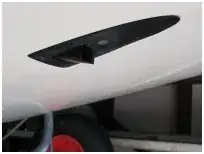
bailer1

bailer of the laser sailoat

The mechanism only works if the boat is moving. The faster it sails, the faster water is drained out of the cockpit, by suction.

Then. Is this an example of the "venturi effect"?

If so, then: why? According to wikipedia

The Venturi effect is the reduction in fluid pressure that results when a fluid flows through a constricted section of pipe

(as the fluid gains speed).

Obviously,

  • there is no constricted section of pipe on the sea behind the boat.
  • the water is not moving, it could be perfectly still. It is the boat what moves.
  • the pressure of the "stopped" sea water can't be lower than that of air on the cockpit, but it happens that the hole continues to suction air while the boat is moving.

Then it is not clear at all (for me) that this occurs by the "venturi effect".

Couldn't it be instead by the suction effect like when you have your hand flat on a table and then you separate the hand from the table very very quickly? (What's the name of this effect?).

Qmechanic
  • 220,844

5 Answers5

2

This is a classic example, often used in fluid dynamics classes, of Bernoulli's principle. This is the principle which underlies the Venturi effect: increasing the flow speed leads to a drop in pressure. The governing equation for an flow of an incompressible fluid such as water is

$$\frac{V^2}{2} + gh + \frac{P}{\rho} = \mathrm{constant}$$

To answer your points one-by-one:

  • The constriction in this case is between the wedge of the autobailer and the water further away from the hull of the boat: when the boat passes over a given 'parcel' of water, the wedge applies a force forward and downward (perpendicular to the plane of the wedge). The fact that the water is incompressible means that to pass the wedge, the flow relative to the boat must speed up.
  • It doesn't matter whether it's the boat or the water that's moving; only the relative velocity between the boat and the water is important in this case.
  • The pressure of the static sea water at some distance from the boat can't be lower than the air pressure, but that in the thin layer which is accelerated by Bernoulli's principle can be the same as the air pressure, meaning that the suction will continue until there's no water left in the cockpit.

Let's look at the situation with the aid of a diagram:

enter image description here

You can see how, from the boat's point of view, the water far from the hull has a velocity $-V_\mathrm{boat}$. The dashed lines represent streamlines; lines along which a given 'parcel' of water moves. As the flow of water past the boat is constricted by the wedge, notice how these lines get 'squished' together. Water cannot be compressed (i.e. $\rho$ in the above equation cannot change), so to get the same amount of water past the wedge in the same time, the water must speed up ($V$ must increase) and hence the pressure must drop ($P$ must decrease).

tok3rat0r
  • 799
2

The Venturi effect is not specific to fluid flow in pipes but rather flow of fluid in general. The basis of the effect comes from the Bernoulli equation which accounts for the energy in a flowstream. Fluid which moves with a high velocity has high kinetic energy derived from a potential (pressure) energy. It's both the conservation and conversion of energy that leads to the lower pressure of the faster moving fluid. Total pressure is conserved but velocity of the fluid in motion is what leads to a lower static pressure, and thus the suction observed in the Venturi relative to the surrounding fluid that's not moving as quickly.

Bernoulli's equation also accounts for pressure force due to head. For this component, fluid density, gravity and depth create a static pressure. The relative velocity of the fluid and hull of the boat must be such that the Venturi drop in pressure exceeds this static head to get water to flow out of the hull.

docscience
  • 11,779
2

I realize I'm very late answering this question, but figured it wouldn't hurt. This isn't Bernoulli or Venturi.

This is simple viscosity and momentum changes. Using tok3rator's diagram marked up a bit:

enter image description here

Look at the streamlines near the bailer-tube (right at the Z2 label). The water is being first forced downward, and then pulled upward. The momentum of the water is changing, and as we know it takes force to change momentum.

  • As the water hits the bailer-tube, the bailer-tube applies a force to the water, literally forcing it out of the way. The bailer-tube applies a force in the direction of the red arrows, meanwhile the water applies an equal and opposite force in the direction of the blue arrow.
  • Once the stream passes the bailer-tube you see that the streamline curves up again. Again, the water's momentum can only change if a force is applied. So without even knowing what is creating the force, we know that a force must be pulling up on the water (red arrow) and the water must be applying an equal but opposite force pulling down (blue arrow).

It's that blue arrow of the water "pulling down" in resistance to it's momentum change that is doing the work, and pulling the fluid it finds in the tube out (aka "sucking"). Newton, not Bernoulli.

If the tube wasn't there, or was blocked off, that region would become a low-pressure turbulent zone as the water is sucked back into the void where the bailer-tube used to be.

Here is a good link from the University of Frankfort discussing the Bernoulli effect and it's many myths which has two examples (evaporator and airflow over a hill) which are the same scenario you were asking about.

Note: The Bernoulli principle gives us a way to compare two points in the same streamline, when those two points are essentially undisturbed, have no energy changes, and no friction/viscosity effects. It is incorrect to try and apply it to the flow in the disturbed region since it's subject to all the above. Both Bernoulli and Venturi are descriptions/principles - they are not forces.

RobotAndy
  • 129
0

enter image description here

As shown in the figure, the red arrow is the direction of the boat, the blue arrow is the direction of the water, and the green line is the plane of the drainage outlet. Because the drain plane is so inclined, the water tends to leave along the normal direction (the black arrow is the normal direction of the drain plane), so low pressure will occur in the area of the drain plane, and the water in the boat will be sucked out.

enbin
  • 2,306
0

I have a sail bot also. but it doesn't have such a sophisticated bailer, its bailer looks more like this: enter image description here

The problem is that it's too slow, and I wish to make it drain the water faster. I was thinking about what mod could be done to increase its performance. The first idea that came to me, was to increase the diameter of the exit hole.

enter image description here

The second idea is to make it touch the water at an angle. enter image description here

Do you think it will work? At least make any sense?

Harish Chandra Rajpoot
  • 2,517
  • 22
  • 25
  • 41
Fabio
  • 1