12

I was carrying a couch with my flatmate yesterday, and I started thinking about this.

Often when carrying objects like this, one person will be taller and has thus lifted his end of the couch higher than the other person's. Additionally, one can intentionally lift his end of the couch higher, for comfort.

My question is, in situation is one person carrying more weight than the other?

5 Answers5

19

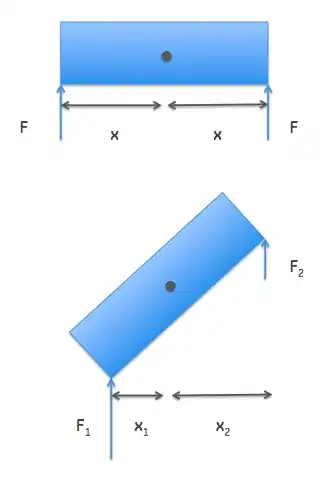
I believe the following diagram tells you everything you need to know: when the center of mass is above the support point, then the lower point will carry more of the weight since it is acting closer to the center of mass ($x_1 < x_2$) and torque balance requires that $F_1 x_1 = F_2 x_2$. Conversely, if the center of mass is below the support, the higher point will carry more of the weight when the object is tilted.

Understanding this diagram really helps when you are moving large objects up or down the stairs: the lower person should grab the object higher up (say the arms of the couch) if you want to achieve more equal weight distribution.

enter image description here

ADDENDUM

In the second case, if the person on the right pushes against the couch, it is possible for the person on the left to end up carrying the entire weight of the couch. In the case of carrying things up stairs that can easily happen... Which is why movers often use webbing straps to permit/ensure a more equal distribution of effort (and to allow lifting with shoulders/back/knees and not just arms).

Floris
  • 119,981
9

Although Floris made a clear picture involving only vertical forces, this picture is mostly useful when carrying washing machines or large chairs, where the 'height' of the object is more pronounced.

However, you will find that, even when the object is mostly flat, the bottom person will carry most of the weight. The key here is the direction of the forces involved.
enter image description here

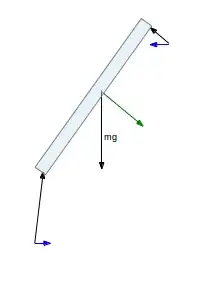
You will find that it's very difficult to lift a couch underneath you, 'tugging' it upwards. Instead, the top person will apply force in the direction that does not require any tugging (especially when you can't get a grip): perpendicular to the object. All you do, is offset the torque gravity incurs on the couch, where we take the bottom person as the pivot point. In the image above, the torque is provided by the component of gravity perpendicular to the couch (green arrow).

Since the top person is twice as far away from the pivot point as the center of gravity, he will only need to apply half of that component which was already less than the total gravity - i.e., much less than half of the total gravitational force. The top person has the easy job, although usually in a very awkward position.

The bottom person needs to account for the rest of the upward force required, along with a small horizontal component to make sure there is no horizontal acceleration (blue arrows) - i.e., a lot more, which is why being the bottom person is the heavier job.

Sanchises
  • 887
1

I'm here on this site after a heated argument with my boyfriend. We were lifting a heavy, long chest together and I was having difficulty because since he is taller, the weight was then shifted over to my end, making it heavier. He insists that the amount of tilt happening was not enough to cause any off balance weight distribution, but I can literally FEEL the object get much heavier when I'm holding it lower, and much lighter when I hold it higher. I've had this experience my entire life and it's so frustrating when someone denies what you experience, saying that it is not true. So I suppose if he is holding the object 3-6 inches higher, am I still getting a substantial amount more weight? Sure feels like it!!

Loula
  • 11
0

I suspect the person lifting their side higher usually supports less weight, but it can go either way depending on how they push/pull.

When the couch is level, suppose both people support the same weight. Because the couch isn't rotating, the people are supporting it at points equidistant from the couch's center of mass, ensuring they exert no net torque.

Next we tilt the couch. The people are still supporting it equidistant from the center of mass. If the forces were all vertical, they would both need to lift the same weight as before because the net torque still needs to be zero.

However, it is likely in this case that the people exert equal and opposite horizontal forces as well. For the flat couch this doesn't matter; the horizontal forces are aligned and exert no net torque. For a tilted couch, if we suppose the horizontal forces are toward the center of mass of the couch (IE the person in front pushes backwards and vice versa), this would tend to torque the couch up to an even higher angle.

Since the couch isn't rotating, there must be some counter-torque. This comes from the lower side increasing its vertical force and the upper side decreasing it. So in this case the lower side supports more weight.

If the people are pulling on the couch (IE the person in front exerts net forward force) it's the opposite, and the person with the higher end supports more weight.

Note: this differs somewhat from Floris' answer due to different assumptions about the geometry; I agree with Floris' answer as well.

-5

If you move heavy appliances or furniture, you'll realize that simple free body diagrams do not capture all the factors. Just imagine 20 feet long counch, rotated upward a log, e.g., 60 degrees. Of course the person at the bottom will bear most of the weight. The free body diagram only applies if couch is suspended using hinged anchor points at either end of the couch. Even in that contrived situation, if there is any nontrival clearance between the bearing and the rod at the 2 hinges, one hinge will bear more weight unless the distance between the centres of the two rods is exactly the same as the distance between the centres of the bearings.