3

So I've been trying to create a mathematical model for an electric motorcycle and began to wonder about the maximum possible torque that could be supplied to the rear driven wheel without having the bike begin to lift up on one wheel. I found ways to calculate this value online; however, the basic concept as to how the bike actually lifts escapes me.

My problem started when I began to think about what axis the bike will rotate about when it is doing the wheelie. My first intuition was that the frame and front wheel, together, rotate about the rear axle. But when I drew a free body diagram of the frame/front wheel system just at liftoff (see below) I made note that the only forces acting about the rear axle, point O, is the force of weight. This means that an increase in applied torque and subsequently, the applied force Fa, should not effect the rotation about the rear axle.enter image description here

I know that the applied force on the back wheel is indeed correlated with the propensity for a bike to wheelie, so I considered that the axis of rotation I was choosing was wrong. If we take the free body diagram above and sum the moments about the center of mass, we would find that an increased applied force would in fact cause the solid body to rotate. The problem with this understanding is that during rotation, the center of mass of the drawn system should actually rises relative to the surface the bike is moving across. If the bike were to be truly rotating about its center of mass, then the back wheel would begin to dip below the surface of the road like you might see in a glitchy video game.

So I suspect that the bike is in fact rotating about the back axle, but I don't understand why, please help!

edit: I added the external torque from the back wheel to the frame, which would allow the bike to rotate about the back axle

edit 2: I suppose that the torque acting on the frame via the engine should not effect the rotation as the movement of a motorcycle can be perfectly replicated by applying a force at the back axle. A third possible axis of rotation might be the lowest point of the back wheel.

Qmechanic
  • 220,844

3 Answers3

5

If we take the free body diagram above and sum the moments about the center of mass, we would find that an increased applied force would in fact cause the solid body to rotate.

Perhaps. Or additional forces can appear. If I push up on my car's bumper, a rotational force is being applied. But the normal force on the wheel farther from me increases, so the total torque still sums to zero.

The problem with this understanding is that during rotation, the center of mass of the drawn system should actually rises relative to the surface the bike is moving across. If the bike were to be truly rotating about its center of mass, then the back wheel would begin to dip below the surface of the road like you might see in a glitchy video game.

Another way to interpret this is that if you apply a small torque and imagine it around the center of mass, you're pushing the rear wheel into the ground. As you do so, the normal force increases. This increased normal force counters the torque you are applying. But the maximum this can be is the weight of the bike. So if you increase past this maximum, the bike will rotate.

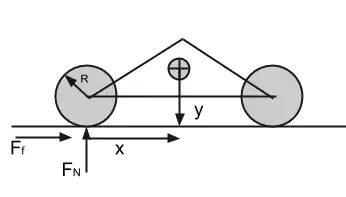
enter image description here

I had originally tried to analyze this from the rear axle, but because the bike will accelerate, this makes fictitious forces appear in the axle's frame that have to be dealt with. We can mostly ignore this by analyzing around the center of mass instead.

I'll ignore friction for now, and just assume that we have sufficient friction to avoid wheel slip. Then the forces we need to consider are the weight, the normal forces, and the frictional force from the road.

As the wheel accelerates faster it provides a torque to the bike. The bike responds by changing the balance of the normal forces. At the limit, only the rear wheel is providing a normal force, and that will equal the weight of the bike. Since gravity acts through the center of mass, the only torques that appear are the normal force and frictional force. When torque from friction exceeds torque from the normal, the bike will tip.

$$\tau_{friction} > \tau_{Normal}$$ $$F_f \times y > F_N \times x$$ $$F_f > \frac{mgx}{y}$$

To tip the bike, the wheel has to push with a force greater than the weight of the vehicle times a factor that depends on the location of the center of mass. \

And since we have the forward force, we can solve for forward acceleration and know that as it begins to tip, the bike will be accelerating at $\frac{x}{y}g$

And then the bit that I think began your question:

...the only forces acting about the rear axle, point O, is the force of weight. This means that an increase in applied torque and subsequently, the applied force Fa, should not effect the rotation about the rear axle.

In your initial diagram, you were neglecting one additional force, and that is the fictitious force due to acceleration of the frame. This force is equal to $ma$ and is applied to the center of mass in the direction opposite the acceleration of the bike. As the acceleration is due to this force, it means it does affect the rotation, even though it wasn't obvious when you started summing torques.

BowlOfRed
  • 42,997
  • 3
  • 68
  • 123
3

Consider torque as a force applied to a lever connected to a rotation point. Torque from the piston to the rotating center of the crankshaft is internal to the engine and will not affect the motorcycle unless the engine is connected by a power train to another rotation point on the motorcycle - the rear axle.

The motorcycle will NOT try to rotate about its center of gravity UNLESS the bike leaves the road entirely, OR if torque applied to the rear axle by the weight of the motorcycle at the front of the body's "lever" overcomes friction between the rear wheel and the road which normally allows engine torque to be translated into forward motion. If that happens, the rear wheel will become a spinning shovel and dig into the road, effectively lowering the rear of the motorcycle, and rotating the motorcycle about its center of gravity.

On the other hand, if the weight of the motorcycle levered to the rear axle provides less torque power than the motive power of the rear wheel meeting the road, the motorcycle will move forward - UNLESS the torque from the engine at the rear axle is so much greater than the torque imparted by the weight of the motorcycle that the outlet of least resistance for the work created by the engine is to rotate the entire motorcycle about the rear axle. Then you get a wheelie and wasted power.

Ernie
  • 8,598
  • 1
  • 18
  • 28
0

This is old, but I feel the points in the answers can be clarified. There are two reasons for a torque that will lift the front wheel.

The first is the engine applies a torque to the rear wheel, accelerating it in a clockwise direction as seen in your diagram. There is a reaction torque, analogous to a reaction force for linear forces. This accelerates the frame of the bike counter-clockwise, lifting the front wheel. This would contribute to a wheelie even on ice. It is important for orienting motorcycles on long jumps (and even more so for flying monster trucks with really large wheels.)

The second comes from the fact that the bottom of the rear tire accelerates the bike forward because of friction with the road. A forward force is applied to the bottom of the bike. The center of mass is above this height. To see why this is causes a torque, see Toppling of a cylinder on a block

mmesser314
  • 49,702