Does that mean that electrons are infinitely stable? The neutrinos of the three leptons are also listed as having a mean lifespan of infinity.
Asked
Active
Viewed 1.6k times


4 Answers
233
Imagine you are an electron. You have decided you have lived long enough, and wish to decay. What are your options, here? Gell-Mann said that in particle physics, "whatever is not forbidden is mandatory," so if we can identify something you can decay to, you should do that.
We'll go to your own rest frame--any decay you can do has to occur in all reference frames, and it's easiest/most limiting to talk about the electron's rest frame. In this frame, you have no kinetic energy, only rest mass energy equal to about 511 keV. So whatever you decay to has to have less rest mass than that--you might decay to a 300 keV particle, and give it 100 keV of kinetic energy, but you can't decay to a 600 keV particle. (There's no way to offset this with kinetic energy--no negative kinetic energy.) Unfortunately, every other charged lepton and every quark is heavier than that. So what options does that leave us? Well, there are massless particles (photon, gluon, graviton). There are also the neutrinos, which are all so close to massless that it took until very recently for anyone to tell that this was not the case. So you can decay to neutrinos and force carriers, maybe. Except then you run into a problem: none of these have any electric charge, and your decay has to conserve charge. You're stuck.
tl;dr: Electrons are the lightest negatively charged particle and therefore cannot decay into lighter particles without violating charge conservation.

zeldredge
- 10,247
46
The statement is true for decays, where lifetimes can be measured.
It is not true for interactions though. A suicidal electron meeting a positron has a good probability to disappear, together with the positron, into two gamma rays, at low energies.
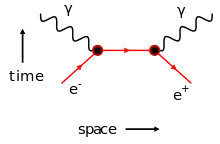
Electron-positron annihilation
It is intriguing that this is not true for neutrinos. If an electron neutrino meets an anti-electron neutrino, the corresponding Feynman diagram would have two Z0s. As the Z0 is very massive, the annihilation/disappearance of the neutrinos could not happen at low energies, in contrast to what happens to electron/positrons.

Peter Mortensen
- 2,348

anna v
- 236,935
16
This is not exactly true. It is believed that net charge is conserved, but there is a weak process called electron capture, where an electron is captured by a nucleus, (usually from an inner "orbital" so there is a spectroscopic signature), a neutrino is emitted and a proton changes to a neutron. So therefore your textbook is wrong!

Rabi
- 201
1
HyperLuminal asked:
"Does that mean that electrons are infinitely stable?"
Think about Dirac's model of an electron, which includes left and right handed contributions.
Now add the (Nobel-worthy) Brout-Englert-Higgs idea, that the left-handed bit interacts with a condensate of weak hypercharge, while the right-handed bit does not.
This suggests a simple extension of the standard model: an SU(2) confinement able to hold together a fermion's left and right hand parts. Think of quark confinement, but at a shorter range.
Regarding "are electrons infinitely stable?", if such fractions of fermions can be associated, then nature may have a process for dissociating them... gamma-ray bursts?
For those working on so-called "WIMP miracles" to explain dark matter, it's this sort of electroweak connection that looks interesting; pre-electronic, pre-photonic, massive pre-fermions evolving into things that can emit photons (and hence be detected).

nnunn
- 31