5

The wavefunctions for atomic orbitals have always been described to me one of two ways:

  1. As a "smeared out" electron standing wave with integer number circumference of de Broglie wavelengths

  2. As a "probability cloud" wherein a point particle electron is likely to be observed.

While those 2 interpretations have never seemed compatible to me, one question seems incompatible with BOTH of these interpretations:

If an electron does not orbit classically, i.e. is not an accelerating point charge in a circular orbit, how does it create a magnetic field of magnitude equivalent to a current carrying loop of orbital circumference?

In other words, why does an electron that is not moving classically appear to produce a magnetic field one would expect from classical movement?

I'm having difficulty understanding how either a "smeared out" or "probability distribution" interpretation of electron orbitals under QM accounts for the non-spin related magnetic moment of an electron, just as if that electron were a point charge in a circular orbit, which QM emphatically refutes?

JPattarini
  • 1,563

4 Answers4

4

It's neither. Those descriptions are just mental imagery for beginners. You need not waste any time on them. All of reality obeys the laws of quantum mechanics. What we call classical physics is just an approximation of quantum mechanics under certain circumstances.

This is important: classical physics derives from QM and NOT the other way round.

You have to stop thinking in terms of shiny classical billiard balls jumping around in some weird way and you have to start thinking about a complex field like object, that, when looked at from 30,000 feet, can produce distributions of expectation values that may look like particle tracks or electromagnetic waves.

For low energies the interactions of the different components of this field, i.e. those that stand for electrically charged fermionic states ("electrons") and those of uncharged bosonic states ("photons") can, on average, reproduce the usual phenomenology for electrons interacting with electromagnetic fields like Lorentz forces.

That is only a small fraction of what the QFT model can reproduce, though. It can also calculate magnetic moments with high precision, explain the hyperfine structure of atomic transition, explain matter and anti-matter and describe its production in e.g. pair-production processes and then some. Taken together, the most complete model that we have, describes almost every aspect of elementary particle physics and motivates the behavior of a wide variety of nuclear phenomena.

CuriousOne
  • 16,486
3

Actually, in a sense, there does exist something which moves. It's not something which can be measured to move, but rather part of quantum mechanical description, evolution of which much resembles classical electron motion: the phase of wavefunction.

See this java demonstration of hydrogen atom orbital. If you select "Complex Orbitals (phys.)" and then choose a state with $m\ne0$, then you'll see how the colours "rotate". This shows that the phase of the wavefunction does rotate around the $z$ axis. In a sense, this can be said to create the orbital magnetic moment.

But please note, I'll repeat: this is not an observable rotation by itself! Moreover, the angular velocity of phase is actually not fixed - it can be shifted by arbitrary constant (provided it's the same for all the states). But it does show how the wavefunction evolves in time. If you try to measure anything, all you can get is the magnitude squared of the wavefunction (for a large enough number of identical experiments). Still, the phase does play a role in creation of superpositions of states and finally in allowing the probability densities change in time, while for stationary states the probability densities are constant in time, as you already know.

EDIT in response to comment:

First, the wavefunction is not real in the sense $\psi\not\in\mathbb R$. It's complex, while all the directly measurable quantities must be real.

Second, despite in eigenstate the atom is stationary, we can make linear combinations of eigenstates with the same direction of magnetic moment such, that the result will be a wave packet measurably rotating in a definite direction.

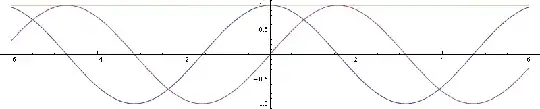
For a simpler example of translational motion instead of rotational, consider a plain wave. Here's how it looks (blue real part, purple imaginary, yellow square of magnitude):
enter image description here

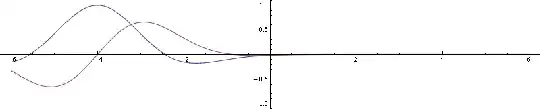
Now let's make up a Gaussian wave packet, like in this demonstration. It'll have the same peak state, but additionally some more states with higher and lower phase velocities (with smaller amplitudes). Here's its wave function (blue real part, purple imaginary):
enter image description here

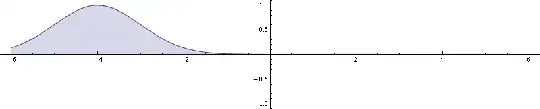
Now this packet has measurable motion. Here's its square of magnitude, which is the probability density by Born rule:
enter image description here

You see that for a particle eigenstate, which is a plane wave, you can't measure its motion. But OTOH, it's the limit of infinitely delocalized wave packet, and for a localized wave packet you can measure its motion (in probabilistic sense, of course).

The same is for rotational motion, it just has some more technical features, which aren't relevant for understanding here.

Ruslan
  • 30,001
  • 8
  • 70
  • 154
2

Although the standing wave is indeed a stationary state, don't make the mistake of thinking this means the electron is not moving. As you say, we know the electron is moving because there is a very real electric current and magnetic moment. So the electron is moving and its wavefunction is not moving.

The confusion comes from our everyday experience, where inertia and dynamics always come together in one package, which we call "motion". But with quantum mechanics we must separate these ideas. What I mean is, a quantum wave can contain motion (inertia) without itself being in motion (dynamic).

[By the way, of the two viewpoints you note, the probability cloud viewpoint is a much weaker view. I mean, from the wave function you can calculate the probability cloud, but the reverse is not possible.]

Nanite
  • 3,530
0

The standing wave describes the relative electron-nucleus motion. The electron itself moves since the atomic center of mass (a plane wave) involves the electron coordinates too.