How can standing waves be produced in an open organ pipe even though both of its ends are open? Can someone explain with more clarity?
Asked
Active
Viewed 1.0k times


5 Answers
29
This is an attempt to explain, in a purely intuitive way why sound waves reflect from the end of an open pipe, and therefore can produce a standing wave.
Consider a pressure wave travelling up the pipe. I've drawn just a single maximum of the pressure wave to keep the diagram uncluttered:
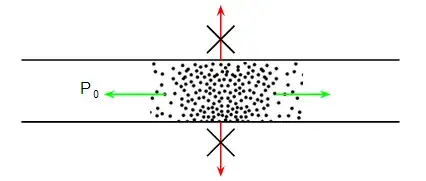
Call the pressure maximum $P_1$ (I haven't marked $P_1$ on the diagram because it doesn't show up against the dots and I can't change the text colour in Google Draw) and the pressure minimum is $P_0$. The pressure wave moves because air flows away from the high pressure $P_1$ and towards the low pressure $P_0$. However because the air is in a tube it can only flow along the tube (green arrows) it can't flow sideways (red arrows) because the tube is in the way. This restriction to the flow will restrict the pressure difference between $P_1$ and $P_0$.
Now consider what happens when the pressure wave reaches the end of the tube:
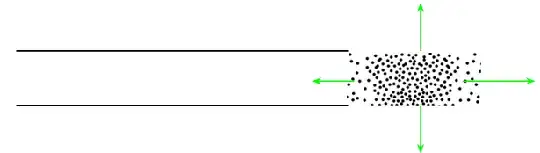
Now the walls of the tube are no longer restricting the flow, so the air can flow away from the pressure maximum in all directions. The result is that the flow away from the maximum will be greater than it was in the tube and the pressure will fall to a lower value than the minimum pressure in the tube:
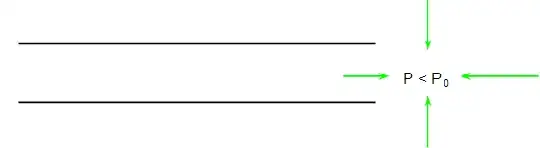
But now the air will start flowing back into the low pressure area, and because the pressure there is less than $P_0$ the rebound will produce a pressure greater than $P_1$:

And this is the last step in our argument. The next wave along travelling towards the end of the tube at a pressure $P_1$ meets a region just outside the tube with a higher pressure $P > P_1$, and the result is a reflected pressure wave back down the tube.
And that's how a pressure wave reflects from the end of an open tube.

John Rennie
- 367,598
10
You may find by starting from first principles, or by consulting external resources that pressure waves in air (in one dimension) are governed by the wave equation
$$\frac{\partial^2 p}{\partial x^2} - \frac{1}{v^2} \frac{\partial^2 p}{\partial t^2} = 0$$
where $x$ is a position and $t$ is the time, and $p$ denotes the pressure difference away from equilibrium. To solve this, let us write the solution as a Fourier transform$^{[a]}$
$$p(x,t) = \int_k \int_\omega \tilde{p}(k,\omega) \cos(kx - \omega t) \frac{d\omega}{2\pi}\frac{dk}{2\pi} \, .$$ Plugging this into the wave equation, we find
$$(-k^2 + \omega^2 / v^2) \tilde{p}(k,\omega) = 0 \, .$$
For each value of $k$ and $\omega$ one of two things must be true: either $\tilde{p}(k,\omega)=0$ or $\omega^2/v^2 - k^2 = 0$. The case where $\tilde{p}(k,\omega)=0$ are trivial: there is no wave. In the other case, for a particular choice of $k$ and $\omega$ we have a wave with the specific form $$p(x, t) = M \cos(kx - \omega t ) = M\cos(k(x \pm vt)) = \cos(kx)\cos(\omega t) \pm \sin(kx)\sin(\omega t)\, .$$ Since the wave equation is linear, these solutions can be summed together to produce other solutions. Furthermore, any solution can be written as a sum of these types of solutions.
Now consider an organ pipe which we stimulate at frequency $\omega$. In this case, the linear combination can be made up of only the following two parts: $$ \begin{align} p(x,t) &= p_{\text{left}}(x,t) + p_{\text{right}}(x,t) \\ \text{where} \qquad p_{\text{left}}(x,t) &= M_{\text{left}} \cos(kx + \omega t) \\ \text{and} \qquad p_{\text{right}}(x,t) &= M_{\text{right}} \cos(kx - \omega t) \\ \text{so} \qquad p(x,t) &= (M_{\text{left}} + M_{\text{right}})\cos(kx)\cos(\omega t) \\ &+ (M_{\text{right}} - M_{\text{left}}) \sin(kx)\sin(\omega t)\, . \end{align} $$
Suppose the pipe extends from $x=-L/2$ to $x=L/2$. The two ends are open to the outside air, so at those points $p \approx 0$. These are our boundary conditions. From the form of $p(x,t)$ you can convince yourself that the only possible solution is when $M_{\text{left}} = M_{\text{right}}$ and $k=\pi/L$.$^{[b]}$ Putting that in gives
$$p(x,t) \propto \cos(\pi x / L) \cos(\omega t)\, .$$
Stop and consider the meaning of this equation for a minute. It is a vibration of air pressure inside the pipe with cosine spatial profile and also cosine oscillation in time. In other words, the pipe, even with its open ends, can made a vibration at the frequency $\omega$. Note that the pressure difference at the ends of the pipe is zero by construction (i.e. our choice of $k$), yet there are still vibration modes!
$[a]$ I dropped a phase here which, if you put it in and follow everything through, doesn't change the argument.
$[b]$ Actually there are more possible values of $k$. They correspond to higher modes of the vibrating air wave. See if you can figure out what I mean :)

DanielSank
- 25,766
5
Simply: the ends of an organ pipe reflect the wave in the pipe. A closed end will cause a pressure antinode while an open end causes a pressure node.
This information is sufficient to determine the vibrational modes of any pipe. If both ends are of the same type (open or closed) the wavelengths of allowed modes will be given by $\lambda = n \, \ell /2$; if the two ends are different, $\lambda = (2n+1)/4 \, \ell$
UPDATE
Following a suggestion by John Rennie, it is worth trying to give an intuitive explanation of the "reflection at an open end" - since it would seem there is "nothing" there to cause a reflection. Here is my way to understand it:
A sound wave normally expands in all directions (think Huygens' principle) but when it it traveling along an organ pipe it is restricted to travel in one direction only - namely along the pipe. When it reaches the end of their pipe, that restriction is suddenly gone - and that is the reason a partial reflection can happen at that point.
Not all the wave can keep traveling forward since the air just outside the pipe "feels different" than the air inside - this is called the acoustic impedance and is not unlike the impedance of an electrical transmission line or the refractive index of an optical medium. Acoustic impedance relates the pressure and amplitude of the wave - and without the walls that changes, as pressure will be lower for same amplitude. For all waves, a discontinuity in the impedance results in (partial) reflection.

Floris
- 119,981
0
Yes there are some nice partial explanations above of how we get reflection back at open end. Also very important is to realize this only happens when the wavelength is similar or longer than the width of the opening ... otherwise with a small wavelength the sound will propagate in the main as straight rays out of the pipe like bullets out of a gun with small angle of diffraction. As the tube gets narrower we can think of a wave encountering a hole and the total energy passing through a hole for this boundary condition drops off much faster than the area (maybe lambda to power 4?) Only a small amount escapes but as the energy inside builds going back and forth resonance, even a small percentage gets appreciable.

blanci
- 367
0
If one considers the airflow in a pipe as a one-dimensional mass on a spring model, an external force pushes particles along the pipe causing a non-equilibrium pressure. This pressurised area moves along the pipe and its motion is opposed by gas particles that are ahead of it and which are at equilibrium pressure, $p_0$. The opposition is called impedance and is proportional to the force at which the (equilibrium) particles are pushed (or subjected to pressurisation): $Z_{in}=\rho_0v_z$. This is what happens inside a pipe where air can move in one direction ($z$) at speed $v_z$.
When the pressurised air reaches the end of the pipe, the impedance rapidly changes because the air now can move in every direction so the $z$-component of velocity of air is strongly decreased for the sake of other directions. The motion of air in this direction is nearly cancelled (assuming air now moves in all directions equally fast - pipe diameter is smaller compared to acoustic wave length and the outlet is the source of spherical waves), and so the impedance of the external medium is close to zero ($Z_{out}=0$ $Pa\cdot s$/$m^3$) compared to the one inside the pipe.
So reflection coefficient at the outlet $$R=\frac{Z_{in}-Z_{out}}{Z_{in}+Z_{out}}\approx \frac{Z_{in}}{Z_{in}}=1$$ and the reflection occurs near perfect and so a standing wave can show up.
Physically the impedance is not exactly zero outside and so the $n$-th reflection will eventually extinguish the wave completely. Not to mention viscosity and other agents responsible for damping the wave.

Radek D
- 145