I've had it explained to me in a separate post that charged particles are constantly exchanging virtual particles with other charged particles and their energy is a steady state. How it is a surety that all of the virtual photons sent out by the charged particle will be exchanged with other charged particles? Are the particles sent in a directed manner toward other charged particles? How much do we know about this interaction/mechanism? Are some virtual particles just radiated away, leaving the charged particle with less energy?
Asked
Active
Viewed 264 times


1 Answers
5
Virtual particles are not real
It's in the name. You may draw Feynman diagrams where there are internal lines, and we call these internal lines virtual particles. They are not real. You will never detect a virtual particle. They are not really exchanged between the real charged particles. Virtual particles are just-so stories designed to explain Feynman diagrams - which are really pictorial representations of the calculation of probability amplitudes - in non-technical terms. Don't think that charged particles continually send out virtual particles (I've seen this in popular science accounts, too).
The idea that charged particles interact via "exchanging" virtual photons come from the fact that the Coulomb force may be obtained by the non-relativistic limit of this diagram:
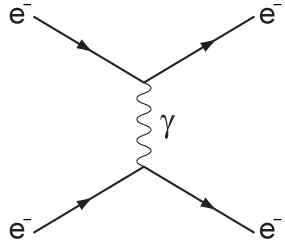
There's an internal line, thus there is a "virtual particle exchanged", but this is not a real description of what is happening, it's a story. The full interaction between two charges in the quantum theory is far more complicated and only approximated by this diagramms, of which "exchange of photon" is a natural-language description which does not do its character as a pictorial representation of a term in a perturbative expansion of the interaction justice.

ACuriousMind
- 132,081