Take a metal disc and cut a small, circular hole in the center. When you heat the whole thing, will the hole's diameter increase or decrease? and why? What will happen to the diameter of disc?
Asked
Active
Viewed 1.3e+01k times


8 Answers
82
Instead of a circular hole, let's think of a square hole. You can get a square hole two ways, you can cut it out of a complete sheet, or you can get one by cutting a sheet into 9 little squares and throwing away the center one. Since the 8 outer squares all get bigger when heat it, the inner square (the hole) also has to get bigger:

Same thing happens with a round hole.
This is confusing to people because the primary experience they have with stuff getting larger when heated is by cooking. If you leave a hole in the middle of a cookie and cook it, yes, the cookie gets bigger and the hole gets smaller. But the reason for this is that the cookie isn't so solid. It's more like a liquid, it's deforming. And as Ilmari Karonen points out, the cookie sheet isn't expanding much so there are frictional forces at work.

Carl Brannen
- 13,059
43
David Zaslavski's answer is correct and complete. But I want to propose a different way to look at the problem.
Think of the disc that was cut out, and imagine that you heat it too, exactly as you heat the plate. After heating, the disc will fit in exactly to the hole, just as if it was first heated and then cut out. Therefore, the hole will expand.

Manishearth
- 19,167
- 6
- 64
- 104

yohBS
- 1,790
39
Good question! Assuming the disc is uniform and isotropic (the same in different directions), the hole will expand in the same ratio as the metal. You can see this because the thermal expansion equation
$$\mathrm{d} L = L\alpha\mathrm{d}T$$
applies to all lengths associated with the metal, including the circumference of the hole, since the edge of the hole is made out of metal. And if the circumference of the hole expands, so does the diameter.
If you have a disc with different regions that are made of different types of metal, or if the metal that makes up your disc has an anisotropic crystal structure (so that it expands by different factors in different directions), then the analysis is more complicated. But in both cases, I think the hole would still get larger since the overall change in size is still an expansion.
In order to get the hole to shrink, you would need to use a material with a negative thermal expansion coefficient $\alpha < 0$, which means it gets smaller as the temperature gets higher. In that case the entire disc would shrink as it heats up. Wikipedia has an entry on these kinds of materials (h/t Kevin Reid).

David Z
- 77,804
24
If you worked in an auto shop, you'd know the answer already.
When an axle gets stuck in a ball bearing, one way to pull it out is to heat up the bearing with a welding torch. The whole bearing, including the hole in the middle, expands and allows you to pull the axle free.

Florin Andrei
- 5,258
12
Im a machinist. We commonly heat holes to expand them in various applications. For example, to install bearings that demand a press fit. We use liquid nitrogen to also freeze the bearings. When both objects return to ambient temps the results are that the hole shrinks. We can even control within some tolerance how much. Consider on an atomic level what is taking place. At the end of day? Heat a hole, and it expands. When it cools it will shrink.

PipperChip
- 2,238

cliff
- 121
4
I think that there is an important assumption at work here. The hole will expand as long as the material is sufficiently rigid; since most things that we want to expand are rigid (jar lids and axle bearings, for example), and since a disk is likely to be made from a comparatively rigid alloy such as steel, it is generally fair to say that the hole would expand. But I think that you could also create a disk in which the hole would shrink; I would expect a hole in a disk made from a malleable material with a high thermal expansion coefficient (such as gold or lead) to shrink.

user10795
- 41
- 2
1
I know it has been answered already. Just a different perspective.
When a solid body is heated, it expands as if we look though a magnifying glass - everything looks bigger, including the hole in the disc.
Hence the hole in the expands when it is heated up.

Rejeev Divakaran
- 171
0
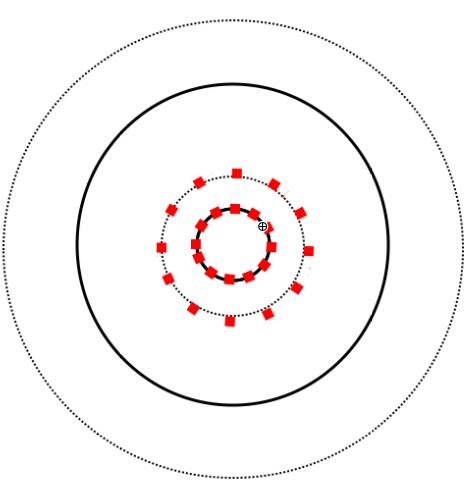
I would like to add a microscopic perspective to this question that were mentioned in comments but which I think deserves more attention. A macroscopic body expands when heated because the average separation between molecules increases.
The picture below shows a disc with a hole. The external and internal radius are showed by solid lines. The red dots along the internal circle represent the molecules in that circle. When we heat the disc the average separation between molecules must increase and of course this happens to molecules in the internal circle as well. Since the numbers of molecules in the internal circle cannot change for a solid, the internal circumference becomes bigger after thermal expansion (dotted lines).

Diracology
- 18,168