1

If nuclear decay rate were affected by sun, then emission probabilities would be subject to sun state and its influence, so quantum randomness would depend on it, Would it still be truly random?

One could argue that randomness would keep intact when consider the whole system..

But what about a non-isolable effect? what if there is no way to "define a system" without a sun/star influence?

If a variation source were found (for example neutrino emission) then perhaps it could be generated intentionally to control decay rates. Could we be sure that emission probabilities would never could be controled to reach 0 or 1?

Thanks for reading

HDE
  • 2,977

2 Answers2

4

If you are referring to a disputed experiment that showed a correlation with the sun's activity , another lab experiment disproved any neutrino flux connection with higher neutrino fluxes than the sun provides . Neutrinos are weakly interacting and the sun too far away for them to set up an effective field to change potential barriers.

There have been experiments that find a tiny difference under different temperatures for various decays, and attributed to the differences in the electron density.

The electron-capture (EC) decay rate of 7Be in C60 at the temperature of liquid helium (T=5  K) was measured and compared with the rate in Be metal at T=293  K. We found that the half-life of 7Be in endohedral C60 (7Be@C60) at a temperature close to T=5  K is 52.47±0.04  d, a value that is 0.34% faster than that at T=293  K. In this environment, the half-life of 7Be is nearly 1.5% faster than that inside Be metal at room temperature (T=293  K). We then interpreted our observations in terms of calculations of the electron density at the 7Be nucleus position inside the C60; further, we estimate theoretically the temperature dependence (at T=0  K and 293 K) of the electron density at the Be nucleus position in the stable center inside C60. The theoretical estimates were almost in agreement with the experimental observations

There are also experiments that say that the casimir effect changes decay rates. All this is research area and liable to errors not well controlled,but @Zassounotsukushi is correct in stating that any such observations will just need different theoretical modelling and will not dispute the randomness of the specific new decay mode.

anna v
  • 236,935
2

If decay rates are found could be reduced to 0, then we are thoroughly wrong in what we thought about nuclear decay, and that is unlikely to happen. The term "nuclear decay" would probably be obsolete in that case. Quantum mechanics, itself, may have answering to do given the strong form of what you are speculating about. But there is little case to believe that will happen. Quantum tunneling is extremely unlikely to be disproved or even modified in any meaningful way.

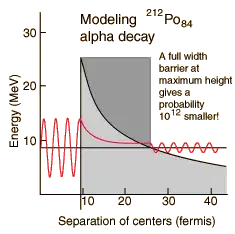
Here is a diagram from a previous question.

Alpha decay

The gist of nuclear decay is quantum tunneling. Now, how could neutrinos from the sun affect this? Well it could be an interaction that is allowable or not allowable under the standard model, although I'm not an expert on that. Whatever it is, however, it's almost certainly not changing the fundamental nature of the nuclear decay by quantum tunneling, which is a truly quantum random process from our view of the universe.

Whatever field or neutrino flux that causes the effect (assuming it's verified) won't be fundamentally changing nuclear decay. It will just be another interaction in the book of nuclear interactions.

Alan Rominger
  • 21,318