4

I am measuring radiation from 6 tritium glow keychains. Usual gamma detector does not detect anything (this is expected), but on beta detector with thin window I am getting about 5 counts per second.

Count rate drops by mere 10% when using 1mm plastic shield.

My understanding is that I am not actually detecting betas, but rather weak secondary X-Ray radiation generated when electrons travel through keychain's plastic. Is that correct?

enter image description here

Jim
  • 24,676
BarsMonster
  • 2,492

6 Answers6

3

I would agree with the general conclusions regarding soft x-rays. I have measured the attenuation of x-rays in every day materials at energies below 20 Kev and to a first approximation can be described by :- E½ = K t^1/3.25 where t is the thickness in cm. E½ the energy at which the intensity is reduction to ½ . K is the coefficient of the material. For example a sheet of solid styrene K = 17.77 and E½ = 8.7 Kev for 1 mm thick sample. While the exact K value will depend some what on your particular specimen it might be interesting to compare the attenuation using other materials.

Cling film 13.3, Black card 18.4, Writing paper 23.5, Black polythene 14.7, Clear polythene 13.3, Mica 51, PCB Fibre glass 40, Beryllium 11.23 , Aluminium 46.6,

3

I also have such a "betalight" and I can provide some data. I took a spectrum with our Amptek energy-dispersive x-ray detector. One can see a Bremsstrahlung spectrum consistent with the maximum beta energy of 18.6 keV. There are also the characteristic zinc K$\alpha$ and K$\beta$ peaks. I attribute those a zinc-oxide phosphor. enter image description here

1

Your conclusion seems reasonable. The energy of the beta particles from tritium is only about 5keV and they're stopped by a cm or so of air, so a 1mm plastic sheet would certainly stop them.

My only concern is that the X-rays are going to be very soft and their intensity very low. A quick Google found this article about using X-rays from tritium decay as a calibration source, but the flux they measure is very low. I wonder whether you are detecting radioactivity from some other source e.g. contamination of the tritium by some other radionuclide.

John Rennie
  • 367,598
1

You are probably not detecting anything related to Tritium. To actually detect the betas you would have to cut the keychain open and use an open gas proportional counter. However, it is a valid method to simply use the photons generated by the keychains to calculate the amount of radioactivity. This is called scintillation detection.

JamalS
  • 19,600
1

After consultation with Pieter who has the most authoritative answer, I will throw in my scintillator results. This image is the result of scanning a tritium keychain with a Hamamatsu R6095 PMT and a 25x10mm NaI crystal running at 800V.tritium keychain with a Hamamatsu R6095 PMT and a 25x10mm NaI crystal Based on Pieter's Bremsstrahlung diagram I have placed the peak at 11keV. The rest of the graph is background radiation.
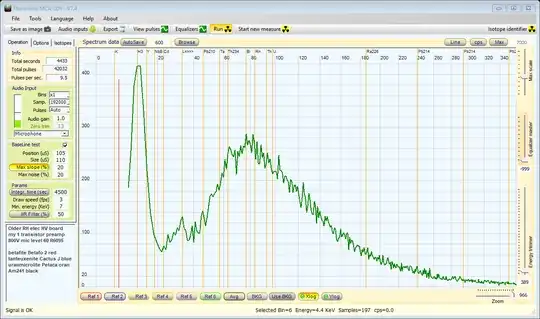
So the answer is that the "usual gamma detector" will indeed detect the Bremsstrahlung that results from the tritium beta decay. By "usual" I mean of course that you are using a high enough voltage on your scintillator so that the energies above at least 10keV are visible.

And, no, it is not caused by weak secondary X-Ray radiation generated when electrons travel through the keychain's plastic. It is caused by Bremsstrahlung xrays as the original beta particle passes close to positively charged nuclei. Diverting the electron from its original path causes a loss in kinetic energy that results in the emission of a photon.
0

My guess is that You are probably detecting X-ray radiation, but not from tritium. The inner surface of tritium keychain (also known as betalight) glass is covered with phosphor. When electrons from tritium beta decay hit the phosphor layer, they excite phosphor and force it to emit photons. I guess that is what You're actually detecting.

Wojciech
  • 1,063
  • 1
  • 8
  • 21