Don't use the final screenplay. I suggest you try Dave Trottier's "Dr. Format Tells All", now in its 4th edition. It is pretty comprehensive, and I have also used his services to review my screenplays, some of them multiple times.
Trottier is a professional screenwriter.
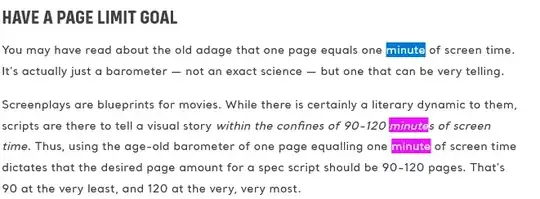
The 1 minute per page, for a professionally written spec screenplay, is an empirical rule of thumb; it is not scientific. For example, in "The Charge of the Light Brigade", there are a few minutes of screen time devoted to a single line of two words in the script: "They charge."
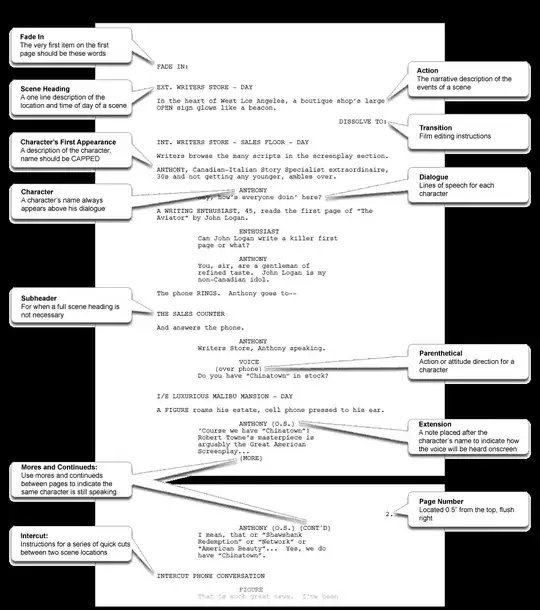
The way the dialogue is formatted, the brief 2 or 3 line scene descriptions and exposition, the "shorthand" used for facial expressions and so on all contribute to the rule of thumb.
For example, in one of my first drafts, Dave shortened my scene descriptions from 5 lines to 2, eliminated a lot of detail (not up to me; up to the directors and set decorators), scratched costume descriptions altogether or nearly to nothing, got rid of all my character descriptions except the bare minimum (e.g. "6 yo girl"). Casting is not your job; the director and casting director will choose the actor, not you, so unless a characteristic is truly necessary for the story, leave it out.
For example, the only specific thing he kept about my character descriptions was an eye color that was a story element in the finale; it is the way a woman realizes a long ago brief acquaintance of her mother, was actually (the woman's) father. Not her mother's husband, as she had been told all her life.
The same thing can go for things like fights. Many times you will see broad descriptions of fights, with few details, because really it is up to the fight choreographers to work with the director on the details, to fit the time the director wants, and to show the angles the director wants.
It is important to understand that the script is just the bones of the story, the images, characters, background music, costumes, art, even non-BG music within the story, if it is not plot critical or perhaps historical (as it was in "Amadeus"), is not up to you. Some things are easier (and cheaper) to license than others. It is the director's job, not yours, to put the flesh on the bones you provide.
If you stick to the format, the rule of thumb "a page a minute" usually holds, at least close enough the director can fudge it in one direction or another to meet their time limit. They are experts at fudging it.
And this format also lets you focus more on what they are looking for when they review your script: A creative plot, believable motivations, and the story beats they expect to find. You are dealing with people that have highly visual and creative imaginations, they don't need any hand-holding to envision the scenes and hear the dialogue with the barest of descriptions.
Trottier also has a book called "Two Screenplays (in Correct Spec Format), which I believe he sold but were never produced, so the rights reverted to him. As examples of actual spec scripts that were bought.
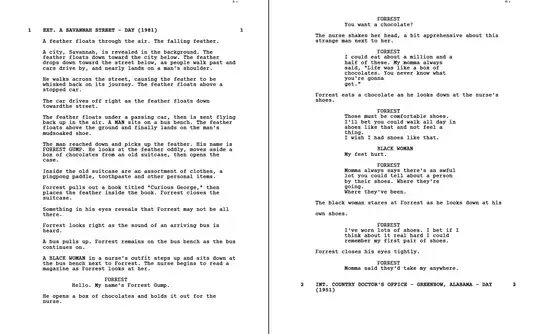
Most of the screenplays you can find online are not Spec Scripts (like you submit to agents or studios), they are shooting scripts or final scripts.
Get some successful spec scripts, it is much easier than you think, once you can let go of the "novelist" mindset.