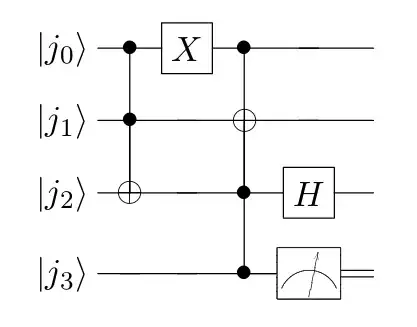
I checked the source code in the qasm2tex.py file. On line 410 the if structure goes like:
if(m):
    (name,nctrl) = m.group(1).split(',')
    tex = m.group(2)
    if(tex=='bullet'):        # special for bullet, no \op{}
        texsym = r'\b'
    elif(tex.find(r'\dmeter')>=0):  # if meas, don't put in \op{}
        texsym = tex
    else:
        texsym = '\op{%s}' % tex
    nctrl = int(nctrl)
    if GateMasterDef.has_key(name):
        print "[qasm_parser] oops! duplicate def for op %s" % line
    else:
        GateMasterDef[name] = (nctrl+1, nctrl, texsym)
    # print "definition: %s" % m.group(1)
    continue
So there are no cases for handling oplus and times is handled, although they're defined along with bullet in the xyqcirc.tex file, as single qubit operations, i.e.
% single qubit operations

\def\op#1{*+[F]{\rule[-0.2ex]{0ex}{2.1ex}#1}}   % operator in box
\def\b{*={\bullet}}
\def\o{*={\oplus}}
\def\t{*={\times}}              % for swap gate
\def\sq{*=<6pt,6pt>[F]{}}           % square, for controlled-phase
\def\m#1{\left[\matrix{#1}\right]}      % matrix shortcut
\def\z{*+[]{\rule[-0.2ex]{0ex}{2.1ex}~|0\>}}    % re-init to |0>
\def\discard{*[]{\rule[-0.2ex]{0.75pt}{2.1ex}~}}    % vertical ``|''
\def\slash{*={/}}               % slash for wire bundles
This is most likely a bug. However, according to the qasm2tex.py docstring it was last updated by Ike (Isaac Chuang) on 2004/03/25 15:36:59, so I'm not hoping that it'll ever be officially fixed. Anyhow, the fix is just a four-line addition to qasm2tex.py, so I'm writing it down here just in case someone finds it helpful or wishes to write their own extension to the code:
if(m):
    (name,nctrl) = m.group(1).split(',')
    tex = m.group(2)
    if(tex=='bullet'):        # special for bullet, no \op{}
        texsym = r'\b'
    if(tex=='oplus'):
        texsym = r'\o'        # special for oplus, no \op{}
    if(tex=='times'):
        texsym = r'\t'        # special for times, no \op{}
    elif(tex.find(r'\dmeter')>=0):  # if meas, don't put in \op{}
        texsym = tex
    else:
        texsym = '\op{%s}' % tex
    nctrl = int(nctrl)
    if GateMasterDef.has_key(name):
        print "[qasm_parser] oops! duplicate def for op %s" % line
    else:
        GateMasterDef[name] = (nctrl+1, nctrl, texsym)
    # print "definition: %s" % m.group(1)
    continue
Now to answer the original question, after the above fix has been made, the required QASM code and the corresponding TeX output is:
%   def cccnot,3,'oplus'
%
%   qubit   j0
%   qubit   j1
%   qubit   j2
%   qubit   j3
%
%   toffoli j0,j1,j2
%   X   j0
%   cccnot  j2,j3,j0,j1
%   H   j2
%   measure j3
%

%  Time 01:
%    Gate 00 toffoli(j0,j1,j2)
%  Time 02:
%    Gate 01 X(j0)
%  Time 03:
%    Gate 02 cccnot(j2,j3,j0,j1)
%  Time 04:
%    Gate 03 H(j2)
%    Gate 04 measure(j3)

% Qubit circuit matrix:
%
% j0: gAxA, gBxA, gCxA, n  , n
% j1: gAxB, n  , gCxB, n  , n
% j2: gAxC, n  , gCxC, gDxC, n
% j3: n  , n  , gCxD, gDxD, N

\documentclass[11pt]{article}
\input{xyqcirc.tex}

% definitions for the circuit elements

\def\gAxA{\b\w\A{gAxA}}
\def\gAxB{\b\w\A{gAxB}}
\def\gAxC{\o\w\A{gAxC}}
\def\gBxA{\op{X}\w\A{gBxA}}
\def\gCxC{\b\w\A{gCxC}}
\def\gCxD{\b\w\A{gCxD}}
\def\gCxA{\b\w\A{gCxA}}
\def\gCxB{\o\w\A{gCxB}}
\def\gDxC{\op{H}\w\A{gDxC}}
\def\gDxD{\meter\w\A{gDxD}}

% definitions for bit labels and initial states

\def\bA{ \q{j_{0}}}
\def\bB{ \q{j_{1}}}
\def\bC{ \q{j_{2}}}
\def\bD{ \q{j_{3}}}

% The quantum circuit as an xymatrix

\xymatrix@R=5pt@C=10pt{
    \bA & \gAxA &\gBxA &\gCxA &\n   &\n
\\  \bB & \gAxB &\n   &\gCxB &\n   &\n
\\  \bC & \gAxC &\n   &\gCxC &\gDxC &\n
\\  \bD & \n   &\n   &\gCxD &\gDxD &\N
%
% Vertical lines and other post-xymatrix latex
%
\ar@{-}"gAxC";"gAxA"\ar@{-}"gAxC";"gAxB"
\ar@{-}"gCxB";"gCxC"\ar@{-}"gCxB";"gCxD"\ar@{-}"gCxB";"gCxA"
}

\end{document}
Circuit Diagram: