First, your camera is not designed to work with batteries below a certain voltage. When it detects an excessively low battery voltage it turns itself off. That circuit stays in the "off" state until voltage is completely removed from the circuit.
When you operate your camera, the current required by your camera varies according to what you do with it. So the typical current required by your camera is less than the maximum current. Theoretically batteries are supposed to have a voltage which doesn't depend on the current you draw from them, but this is only an approximation. In fact, all batteries have a negative V-I curve; if you increase the current taken from them, their voltage decreases. This effect is like having a resistor in series with the battery. It is called the "internal resistance" or impedance sometimes. Usually it is a very small effect but the dead voltage sensor in your camera can be very sensitive and so small effects can make a big difference. In addition, as a battery runs out of juice, its internal resistance increases [also see] and so the slope of its IV curve increases.
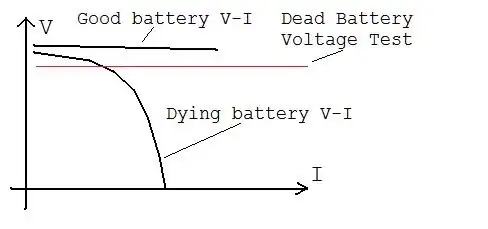
As you use a camera, the current requirement goes up and down. As the batteries run out of power, eventually the maximum current usage will give a voltage that is too low for your battery's voltage detection circuit. At that time your camera will turn itself off.
Your swapping the batteries had no effect on their voltage. (Okay, there might have been a very very slight effect from your hands warming the batteries slightly, but this effect is probably quite small compared to the effect I'm describing here.) Instead, what you did was to reset the dead-battery circuit. After 15 minutes, either you did something that increased the battery current enough to again trigger the dead-battery circuit, or possibly the small current drain caused the battery to become even more dead than it already was.