12

The geodesic equation (let's suppose that we're talking about massive particles, so I'll parameterize the path by proper time $\tau$)

$$\frac{d^2 x^\mu}{d \tau^2} + \Gamma^\mu_{\rho \sigma}\frac{d x^\rho}{d \tau} \frac{d x^\sigma}{d \tau}=0$$

is invariant under $\tau \rightarrow -\tau$.

However, falling particles clearly have a direction, they always fall in instead of out. Formally, how does a falling particle 'know' which way to move in $\tau$?

Qmechanic
  • 220,844
Andrew
  • 121

5 Answers5

14

If you take any solution to the geodesic equation, the time-reversal of that will also be a solution. If one describes a rock falling down in the Earth's gravitational field, the other will describe a rock that was tossed up at some point in the past. The situation is just like Newtonian gravity in that respect.

Mathematically, $\tau$ is just a parameter used to label points on the path. Physically, we have a clear understanding that one direction of $\tau$ is "toward the future" and one is "toward the past," but the fundamental equations of (non-statistical) physics don't distinguish between future and past. That's true for general relativity, Newtonian mechanics, electromagnetism, etc.

Ted Bunn
  • 20,263
4

A geodesic parallel-transports its own tangent vector, so if you "start" the particle pointing into the local (time-like) future it will follow the geodesic in that direction by definition.

Actually, how does a particle "know" how to move forwards in time in plain Minkowski space for that matter? Microscopically it doesn't, this is also put in by definition as for example you can consider antiparticles to be particles travelling backwards through time. Then you have to decide which sort to call particles and which to call antiparticles..

Tau is just enumerating the points on a geodesic path in GR. You still have both forward and backward-tilted lightcones along the path, so somewhere you have to make a choice (which will be conserved by the geodesic as I wrote above).

BjornW
  • 7,217
3

Reparametrizing the geodesic doesn't change the geodesic at all. The geodesic is simply a set of points, and that set of points gives a complete description of the motion. Reparametrizing doesn't change the set of points.

So reparametrizing like $\tau\rightarrow-\tau$ doesn't reverse the motion. You can see this in Minkowski space, where motion in opposite directions is represented by two different lines (two different point-sets) in the $x-t$ plane. Similarly, $\tau\rightarrow2\tau$ doesn't affect the validity of the solution to the geodesic equation, and it doesn't represent motion that's slowed down by a factor of 2 (which obviously wouldn't be physical in most cases).

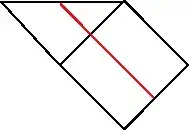
GR doesn't even have a general notion of global time-reversal. For a given spacetime and a given geodesic, you're not guaranteed to have any well-defined notion of what the time-reversed version of the geodesic would be. For example, here's the Penrose diagram for a black hole:

enter image description here

The red line is a (null) geodesic. It is not even possible to define a time-reversed version of this geodesic. Locally, time-reversal would mean flipping it so it had the opposite slope. But globally, there is no specific line with the opposite slope that deserves to be called the time-reversal of the red line.

1

What you have noticed implies that both solutions (in and out) are acceptable physical solutions (that is, observing them would not be in violation of known principles). But which solution the particle happens to follow depends on the initial conditions of the motion. I would add that this is not restricted to GR.

Sensing the direction of the time is an "emerging" feature (we have found out that entropy increases, so we can "order" two snapshots taken at different times: the egg was whole, then it was broken and not viceversa).

Francesco
  • 119
-1

A (stationary) "well" ($W$) has a certain geometric asymmetry (among a system $S_W$ of participants who remain rigid wrt. each other, "around" well $W$)
from which derives the "direction of (initial) free-fall upon being released from the rigid system" or short: the "direction straight into the well, ${\widehat {\mathbf a_W}}$"; vs. other directions.

If some (other) "particle" (${\mathbf P}$) met and passed some members of the rigid system $S_W$ in some particular order, and if they were asymmetric to each other in terms of direction ${\widehat {\mathbf a_W}}$ then particle ${\mathbf P}$ is said to have "fallen in" (or "risen out of") well $W$ (regardless of whether or not it had been otherwise "free").

If the order of those passages was entirely or predominantly towards direction ${\widehat {\mathbf a_W}}$, formally

$\langle {\widehat {\mathbf a_W}} \cdot {\mathbf P} \rangle \gt 0$,

where the ordered set ${\mathbf P}$ is understood as directed "from past to future",

then particle ${\mathbf P}$ is said (or "'knows'") to have fallen in the well, instead of risen out.

user12262
  • 4,360