7

I am reading up on optical fibers and there's one thing I haven't understood yet:

  • Does an optical fiber preserve the angles of incoming light?

For example, if we light two LEDs in front of an optical fiber (within its acceptance cone) and hold the other end of the fiber in front of a paper, would we see two separate light dots on the paper (because the angles of the incoming light were preserved), or just one (because the angles were messed up...)?

(Another way of posing this question: What would I see if I looked into the end of an optical fiber – would I see what's in front (within the acceptance cone) of the other end of the fiber or just a blurry dot? - disregarding I would need extremely good eyesight etc...)

4 Answers4

4

Two extreme cases:

For a very thick multi-mode fiber, the angles are somewhat preserved I think.

The opposite extreme is a thin single-mode fiber, in which the angles are most definitely not preserved. The light enters the fiber or it doesn't, there is no other spatial or angular information.

So the answer to your question is: it depends on the fiber!

Steve Byrnes
  • 17,082
4

Well, ya gotta be careful. As you noted, there's an acceptance cone angle. Now, consider an idealized case where the fiber is perfectly straight and perfectly cylindrical. Then, even for skew rays (per wikipedia, "ray that does not propagate in a plane that contains both the object point and the optical axis. Such rays do not cross the optical axis anywhere, and are not parallel to it") you can determine the local angle of incidence when they hit the internal $n_1/n_2$ index boundary, and see that the rays may end up with different vector angles $ (\theta,\phi)$ (with respect to the X and Y coordinates) but basically the same range of angle with respect to the optic axis.

All this is a long-winded way of pointing out that light paths have to be reversible, so a ray can't exit at an angle greater than the acceptance angle.

However, if you feed a beam with angular spread less than the acceptance angle, it's more than likely that multiple skew bounces, and, more important, curvature in the fiber, will lead to exit angles as large as the acceptance angle.

Carl Witthoft
  • 11,106
3

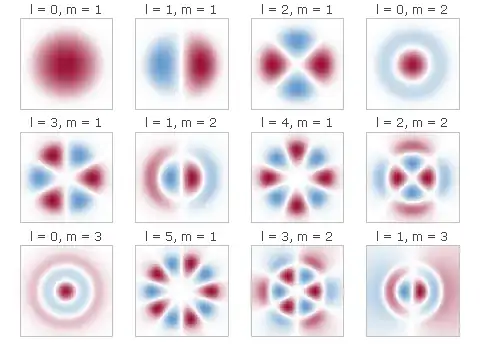
Light travels through an optical fiber in a set of discreet "modes". Each mode correspond to a specific angle at which the light field propagates, bouncing up and down in the fiber. Depending on the wavelength and the type of fiber (diameter, refractive index, etc.) there may exist one or several propagation modes. Then the method of coupling light into the fiber determines which one(s) is/are used. The output beam is generally pretty diverging.

enter image description here

To calculate the modes, you have to consider the electric field in the fiber and the constructive/destructive interferences that make the modes exist or not. More info can be found here

Anael
  • 355
0

An endoscope uses a bundle of multimode fibers. The number of fibers determines the resolution of the image transported through the fiber bundle. The angle of light isn't preserved in a single fiber. Usually - depending on the length and bending of a such a multimode fiber - angles/modes will be mixed in some way; therefore you need a bunch of fibers to preserve angular or spatial information of light using fiber technology.

yuggib
  • 12,357