From the Penrose diagram of de Sitter space, we see it has a future and past conformal boundary, and they are both spacelike. So, does de Sitter space admit an asymptotic S-matrix? Sure, in the usual coordinates which only cover half of the full space, we don't have an S-matrix because it's not causally complete, but in a coordinate system which covers the entire space, why not? Just because we don't have a globally timelike Killing vector field doesn't mean we can't have an S-matrix.
Asked
Active
Viewed 1,821 times


1 Answers
9
Dear inflation, the answer is No, one can't define an asymptotic S-matrix in de Sitter space. See e.g. section V.A. in this paper by Bousso:
The problem is that the Penrose diagram of a de Sitter space starts and ends with a horizontal line. So at the beginning, the observer is forbidden - by causality - to set up the initial state on the initial horizontal line (because he can only affect its future light cone, a small triangle); and at the end, for a mirror reason, he can't measure what happened.
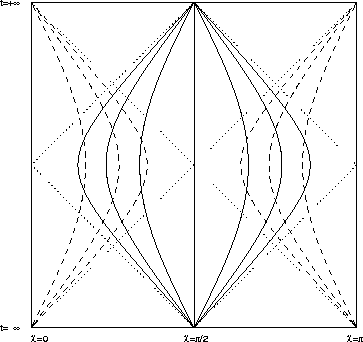
So at most, if such an S-matrix existed, it would dictate the evolution of states that no one can prepare to states that no one can observe, as Bousso says. This S-matrix would not be an observable, it would be a "meta-observable".
There are good reasons to think that this is not just an aesthetic conflict with the "testability" criteria in science. It's usually the case in physics that if one can prove that something can't be measured, not even in principle, it doesn't make sense. Attempts to measure/define the values of $x,p$ with a high accuracy that violates the uncertainty principle is a canonical example. We know that it's not just because of our technological limitations; accurate values of $x,p$ simply can't exist at the same moment. The operators don't commute with one another, after all.
In the case of the hypothetical de Sitter S-matrix "meta-observable", the experience with the uncertainty principle suggests that e.g. the "arbitrary" initial state indeed can't be prepared - surely not by an observer, as argued above, but not even by God or Nature - because the degrees of freedom that belong to vastly separated regions on the infinite initial line are not really independent of each other. This notion is known as the complementarity - and while it's usually talked about in the case of black holes, de Sitter space offers a straightforward generalization.
De Sitter space may be thought of as a black hole but the "inner visible part" of the Universe should be identified with the black hole exterior while the black hole interior is the infinite region behind the cosmic horizon of the de Sitter space. Much like the microscopic information about the black hole interior is ultimately imprinted in the Hawking radiation, one should believe that all the information about physics beyond the cosmic horizon is imprinted to detailed properties of particles in the visible patch.
For similar reasons, the fact that the de Sitter horizon has a finite entropy - because the cosmic horizon has a finite area - should be taken pretty seriously and it arguably applies to the whole space and not just the visible patch. Because of the finiteness of the entropy, it seems that one can't define any observable that is arbitrarily accurate and that depends on continuous parameters such as momenta, not even in principle.

Luboš Motl
- 182,599