Hawking radiation is more about the inward flow of negative energy (and outward flow of positive energy) caused by the action of the gravitational field.
As for black holes, there's a pretty simple way to check how tachyons react. Just looking at a conformal diagram :
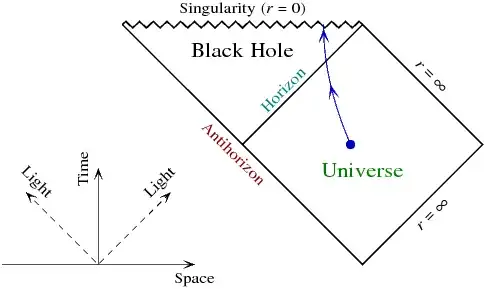
(from this page for the source)
Conformal diagrams have the nice properties of identical causal properties with the original metric and that all light cones are at a 45° angle. Without breaking much of a sweat, you can see that even a casually spacelike curve would be able to get out of the event horizon.
Another way would be to look at the Kruskal coordinates
$ ds^2 = \frac{32M^3e^{r/2M}}{r} (-dT^2 + dX^2) + r^2 d\Omega^2 $
The horizon is at $T = \pm R$, the interior region at $T^2 - R^2 \in (0,1), T > 0$, the outside at $T^2 - R^2 < 0, R > 0$. A curve of the type
$T(\tau) = 1$
$R(\tau) = \tau$
will go from the singularity (or we can start a little way outside of it to avoid troubles) and go to infinity. Its tangent vector would be
$u_a = (0,1,0,0)$
and its curve will have the length
$l = \int_\varepsilon^\infty \sqrt{\frac{32M^3e^{r/2M}}{r}} dt$
which is obviously spacelike.
I'm not too sure how a free tachyon will fare, though I guess you just need to turn the Schwarzschild geodesic on its head and make it spacelike. But from the conformal diagram, my guess would be that a tachyon might actually have a hard time hitting the singularity.


