6

I was near ($\approx40m$) an overhead power line and I heard a sound coming from the cables of the power line; I think the sound was made by the vibrations of the power cables due to the wind but I am not sure. The wind was very light.

The sound was not the "buzz" asked about here.
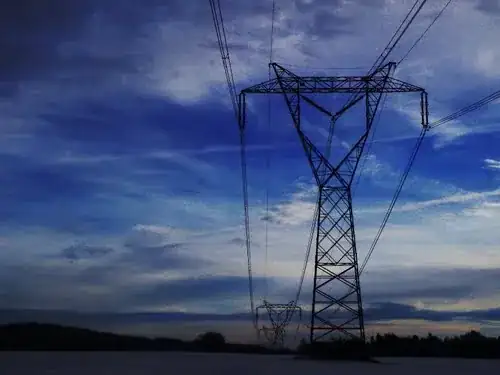
enter image description here

My question is: assuming the sound was generated by the wind, is it possible to estimate the speed of wind from the sound properties (i.e. its spectrogram) and the mechanical properties of the cable?

If yes, how accurate will be the estimate?

If yes, can you provide some back-of-the-envelope calculation?

2 Answers2

6

The sound by the cable is produced because of the Kármán vortex shedding.

This empirical formula from the wikipedia page relates the frequency of the vortex shedding with the Reynolds number: $$ \frac{fd}{V}=0.198\left (1-\frac{19.7}{\mathrm{Re}}\right), $$ where $f$ is the frequency, $d$ cable diameter and $V$ is the flow velocity. The Reynolds number $\mathrm{Re}$ in turn is defined for this system as $$\mathrm{Re}=\frac{Vd}{\nu},$$ where $\nu$ is the kinematic viscosity of the medium. For the air at $15\,{}^\circ \text{C}$ it is $1.48\times 10^{−5}\,\text{m}^2/\text{s}$.

So solving the equations for the velocity $V$ we obtain $$ V = 5.05 \left(f d + 3.90 \frac{\nu}{d}\right). $$

Of course, this formula implies idealized conditions, so in a more realistic situations (including for instance turbulence in the wind flow) extracting the vortex shedding frequency from the sound spectrum could be tricky.

user23660
  • 5,927
1

In the design of aeolian vibration dampers the frequency of oscillation is given empirically by $$ f = 3.26 V/d $$ where $f$ is in $\rm Hz$, $V$ wind speed in $\rm mph$ and $d$ the cable diameter in $\rm in$. The problem is that beyond $15 \,{\rm mph}$ the wind is too choppy to excite one frequency and the vibration amplitude (and hence sound) drops. Only across flat terrain (sand, river crossing, snow cover) the vibration can be sustained up to about $25 {\rm mph}$.

Thus the vibration frequency can only be used for low speed, and steady winds.

John Alexiou
  • 40,139