-4

It is commonly held that the universe is expanding but instead matter could be shrinking. This could occur due to an increasing dilaton field implying that compact extra spatial dimensions are shrinking.

In order to test this hypothesis one could construct a system comprising a pair of charged spheres such that their gravitational attraction is balanced by their electrical repulsion.

Since each force falls off inversely with the square of the separation distance between the centres of the spheres then that distance cancels from the balance equation and is not determined by any physical principle.

Now if one measured that separation distance and found it to be slowly increasing then that shows that one’s ruler must be shrinking. Therefore one would prove that matter is shrinking rather than space expanding.

Is there any merit to this proposal?

Qmechanic
  • 220,844

3 Answers3

1

Controlgroup makes the point that the Hubble constant is too small to measure the way you are thinking (+1). But suppose it was bigger. Suppose the Earth and moon shrank 1% in a year.

If we lined up a bunch of rulers, we would indeed think distance to the moon was 1% bigger. But suppose we measured by measuring the time it takes a pulse of light to travel to the moon, bounce off retroreflectors, and return. We would get the same distance.

You might also find this Veritasium video interesting. What Actually Expands In An Expanding Universe?

mmesser314
  • 49,702
0

Now if one measured that separation distance and found it to be slowly increasing then that shows that one’s ruler must be shrinking.

I think you overestimate how fast the Universe is expanding/matter is shrinking. The Hubble constant is somewhere around $70\,\text{km/s/Mpc}$. Seventy kilometers per second of recessional motion, per megaparsec of separating distance. Seventy kilometers per second recessional motion per ~$3.1\times10^{22}\,\text{m}$ of separation. 2.26 attometers per second recessional motion per meter of separation. ~0.1% of a proton width per second recessional motion per meter of separation.

This is why it’s impossible to measure Hubble expansion directly on objects like that. LIGO and other laser interferometers, with mirrors kilometers apart capable of detecting proton-scale movement, could theoretically get to this kind of precision, but as far as I’m aware measurements suggesting that the distant mirror was approaching the laser (as a shrinking-matter theory would suggest, like you say) have not yet been made.

That is, you could theoretically check this, but not with that apparatus.

controlgroup
  • 8,801
0

This device is based in the SMTwVSL (Shrinking Matter Theory with Variable Speed of Light) (1). This is an answer to the most challenging question that can be asked about a theory, which is: How can we test this theory? In this case, we can ask:

How may one test if matter shrinks or not?

The device for detecting matter shrinkage must be based on interferometry technology.

The arrangement of the apparatus is similar to the old “Michelson-Morley experiment”, but the mirrors are replaced by optical fibers with another beam splitter to join the two beams from the first beam splitter. The introduction of new technologies in the production of the coherent laser beam, in the phase and polarization control and in the photodetector is essential for the proper functioning of the equipment. A room with strict temperature control is required.

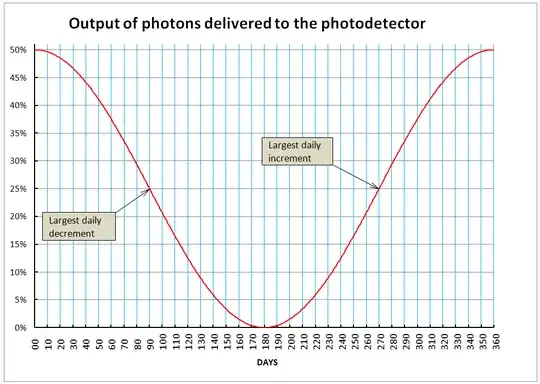
The large difference in the length of the two optical fiber results in a build-up of photons inside the larger optical fiber. The shrinking of the optical fiber and wavelength at different rates, combined with the increasing light speed, result in a decreasing in the accumulation of photons, changing the interference pattern in the output of the second beam splitter. The length of the large optical fiber was adjusted in this project to give one phase-shift in 360 days, to simplify the analysis, resulting in a phase shift rate of one arc grad per day. This is a schematic optical apparatus This is a sine graph To take fast results we could adjust the phase compensator to obtain the largest day decrement, with measurable results in one day. The change in the largest daily decrement position is about 0,87% per day.
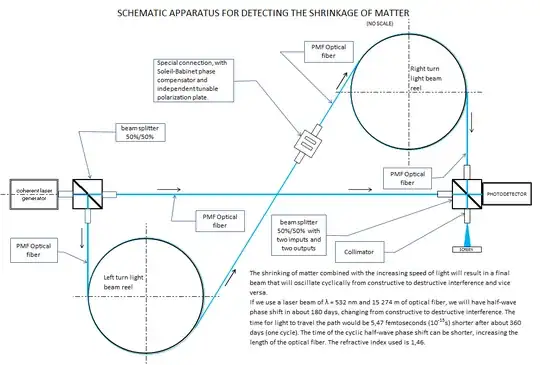
It is worth noting that this result is dependent on the Hubble constant. The constant “KA” is proportional to the inverse of the Planck constant (h-1), so this device would serve to definitively end the eternal tension of this constant, which in any case would no longer be used. This apparatus can detect the shrinkage of matter at any rate it occurs. If the shrinkage does not happen, the amount of photons delivered to the photodetector will be constant at any time.

Table from SMTwVSL (1)
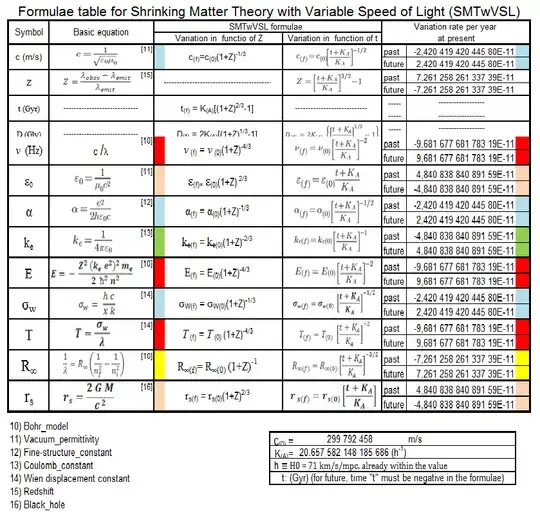
This is a table of formulae References:

  1. da Mota Filho, Azor Romão. https://vixra.org/abs/2205.0001. https://vixra.org. [Online] 30 de 10 de 2023.