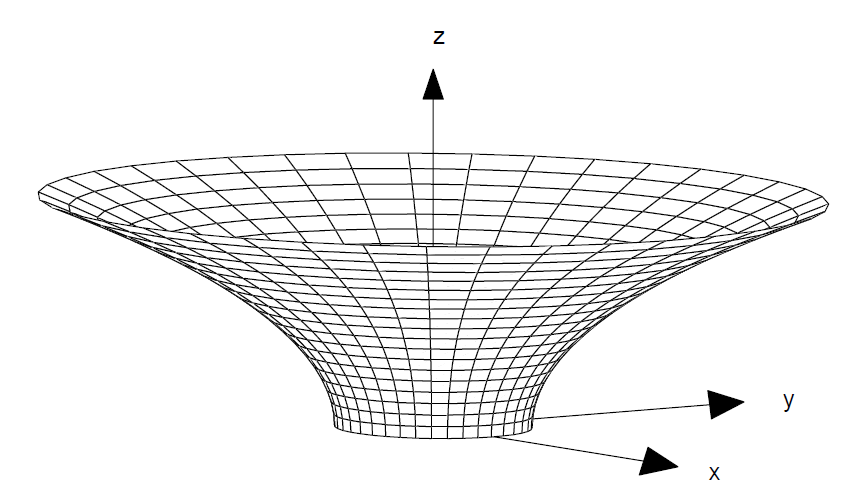
You are right to be skeptical about the curvature being different when illustrations go to lower dimensions. Differential geometry is unfortunately very sensitive to the number of dimensions of the manifold. Just to illustrate, suppose we simplified it down to please the flat-Earth folks and pretended that the Earth was two-dimensional. We then set out to solve Einstein's field equations for orbit. Since orbit is a vacuum, this amounts to setting the Ricci tensor equal to zero: $$R_{uv}=0$$
Spoiler alert: the solution, in two-dimensions of space, is zero gravitational field. Spacetime in less than three dimensions of space is just not rich enough to have nonzero curvature but with zero Ricci tensor. Gravity in one dimension of space and one dimension of time is even more sickly.
So, the most accurate picture of gravity in general relativity is just the full picture, and most visuals (especially the horrid trampoline analogy) don't do it justice. As you've already gathered, this is annoying because we didn't evolve to imagine four dimensions of spacetime. That being said, there are some intuitive ways to get around this. Some previous replies have already given a few of these.
I'll discuss one I've used for a while now that I keep returning to. In the weak field approximation, the overwhelming majority of the gravitation we experience is due to the $g_{00}(x,y,z)$ component of the spacetime metric. This controls time dilation as a function of location, rather than spatial curvature. One way to leverage this is to imagine space flowing, like a river, towards gravitational wells. This is known as the river model. A great paper by Braeck and Grøn explain this in mathematical detail, while the YouTube channel ScienceClic English has a fantastic video illustrating this point of view with animations that show why it works so well.
This is a good enough way to think that you can easily derive the equation for gravitational time dilation in orbit by just imagining someone falling from infinity and then invoking the equivalence principle before they land. They will land, by energy conservation, at the planet's escape velocity $$v_e=\sqrt{\frac{2GM}{r}}$$
But when they land, by the equivalence principle, they are no longer moving in the original inertial freefall frame they were once in. In a sense, they are now moving against that frame at a constant speed of $v_e$ which means the good old fashioned time dilation formula from special relativity can be used: $$\Delta \tau=\sqrt{1-\beta^2}\Delta t=\sqrt{1-\frac{2GM}{c^2 r}}\Delta t=\sqrt{1-\frac{r_s}{r}}\Delta t$$
Including length contraction follows immediately by the same logic, and the solution in orbit $$\Delta \tau=\sqrt{1-\dfrac{3}{2}\dfrac{r_s}{r}}\Delta t$$ is also easy using a little vector argument. This is remarkably elegant for solving what is essentially the full blown Einstein field equations for the Schwarzschild metric, which is no easy task from the point of view of differential calculus. It's as if space itself is falling inwards towards the Earth at a speed of the escape velocity.
That answer might not be exactly what you were looking for, but hopefully it gives you another tool for thinking about general relativity without the heavy mathematical machinery.