Firstly, let us define the term elastic potential energy and briefly talk about the fundamentals behind why it arises.
Elastic potential energy is the energy stored in a stretched or compressed object (this stretching/compression has been carried out by an external force applied to that object), such as a spring. Fundamentally, it relates to the chemical bonds within that material that holds all of its atoms/molecules together.
Suppose we have a vertical spring of force/spring constant $k \,\,Nm^{-1}$ with its original length. A mass (an external object) is suspended from the bottom of the spring,causing an external force to stretch this spring downwards, leading to it extending by $x$ metres. As you already know, the elastic potential energy is equal to $\frac{1}{2}kx^2$ Joules.
But is this elastic potential energy stored in the object - the mass stretching the spring - or the spring itself? Well, it is clear that the mass has lost gravitational potential energy (GPE) due to its height being $x$ metres lower than its initial position when it was first suspended on the spring - if the mass has a mass of $m$, the value of this "lost" GPE is $mgx$.
Now, let us assume that there are no energy losses in this system and the only conversion is between GPE and elastic potential energy. The "lost" GPE of the mass has been converted to the elastic potential energy of the spring - energy is conserved and physics works! Hence, the elastic potential energy (at least as far as I know) is definitely stored in the spring that stretches, and is provided by the conversion from the GPE of the mass to the elastic potential energy of the spring.
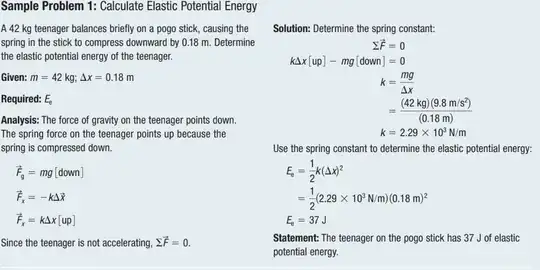
In terms of the question in your textbook, I think it should say the elastic potential energy of the spring in the pogo stick, not the teenager - if you do any further investigation into this, do correct me if I'm wrong. But anyways, since the teenager loses $42g\cdot 0.18=7.56g$ Joules of GPE, the elastic potential energy stored in the spring must also be $7.56g$ Joules, which (if we assume $g=9.8\,\,ms^{-2}$) is equal to $74.088$ Joules - ideally, this should be written to 2 significant figures (the same number of s.f. as $0.18$m), hence the answer would be $74$ Joules.
I hope that this answer has been helpful.