3

So I've been doing some research for a while now, and yesterday came across the video of PBS space time talking about what happens to quantum information in a black hole. In the thought experiment about Bob and Alice, he does mention that when approaching the black hole, Alice doesn't get spaghettified but pancakified because of the small tidal forces of the black hole. The argument is that indeed this black hole was so big that the difference in pull, at the human scale, was not great enough for her to experience spaghettification.

So now I came with a question, maybe a dumb one at it, but why does spaghettification appear so much more frequently than pancakification? I've personally never heard of pancakification, and is very triggering since the two phenomenas are quite extreme opposites.

So I thought that maybe, for ordinary scale black holes, spaghettification is the one phenomena happening, as opposed to supermassives black holes, that would be much bigger than ordinary ones. And so, since those black holes are less frequent, would be talked about as "special cases" of black holes, making the pancakification phenomena less talked about. But since that is only a hypothesis, I don't know if it could also be tied to what black holes it is (such as kerr, Schwartzchild, [...]). I also don't quite get the pancakification phenomena either, but i'll try to do some more research on the subject and ask another question later (I'm new at this, can we have two questions in the same post?) I don't know much about the physics behind them either, I'm only in 12th grade, so I'd hope you could go easy on the mathematics, but any answer would help me a lot!

Qmechanic
  • 220,844

2 Answers2

7

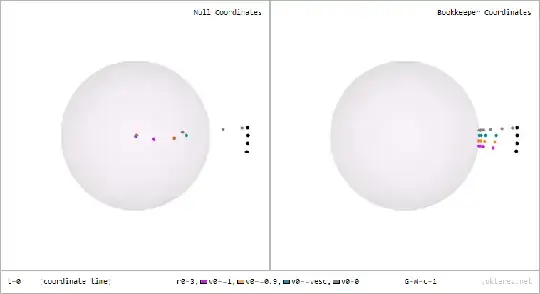
Susskind explains it here: the pancakification due to gravitational time dilation is only in the reference frame of Bob. In her own frame Alice gets spaghettified, not pancaked, since the local tidal forces are positive all the way.

On the left you have an infalling stream of particles with different initial velocities in ingoing Eddington-Finkelstein coordinates where you can see the local spaghettification, and on the right the same particles in the classic Schwarzschild-Droste coordinates where you can see the pancakification in the frame of the stationary coordinate bookkeeper:

enter image description here

Yukterez
  • 14,655
6

I watched the video, and it's important to note that the term pancakification is not used anywhere else at all. However, it is interesting to see what the video tries to say. Without going too deep into general relativity, the effect can be explained purely Newtonian as well. I will keep the mathematics as simple as possible. Say we have Alice of mass $m_A$ and length $L_A$, then the Newtonian difference in force between her head and her feet will be:

\begin{equation} \Delta F = \frac{GMm_A}{r^2} - \frac{GMm_A}{(r+L_A)^2} \end{equation}

with $M$ the mass of the black hole. The idea of 'spaghettification' is now that this difference will be so large, that her head will inevitably be pulled apart from her feet. We can rewrite the force difference as: \begin{equation} \Delta F = \frac{GMm_A}{r^2}\left(1-\frac{1}{1+\frac{2L_A}{r}+\frac{L_A^2}{r^2}}\right) \end{equation} with $L_A\ll r$, so the denominator terms are almost zero. We can make a taylor expansion to estimate the behaviour. Know that for small $x$, $\frac{1}{1+x}\approx 1-x+\ldots$, so we have:

\begin{equation} \Delta F \approx \frac{GMm_A}{r^2}\left(1-1+\frac{2L_A}{r}\right) = \frac{2GMm_AL_A}{r^3} \end{equation} where I ignored quadratic terms due to being too small. Let's evaluate this approximation for the force difference at the event horizon/ Schwartzschild radius $r = \frac{2GM}{c^2}$:

\begin{equation} \Delta F \approx \frac{2GMm_AL_A}{\frac{8G^3M^3}{c^6}} = \frac{m_Ac^6L_A}{4G^2M^2} \end{equation} Even in this Newtonian approximation we can see what's going on. First of all, if Alica is longer ($L_A$ is bigger), the force difference will evidently be larger. Secondly, at the event horizon, we see that the force difference scales as $\sim 1/M^2$: the larger the black hole, the less spaghettification we have, simply because the event horizon distance is much farther away. Indeed for these super massive black holes the spaghettification process will not occur (to properly calculate the effect, you would need general relativistic calculations of course).

The idea of 'pancakification' is now that since objects seem to freeze at the event horizon, for an outside observer (Bob) Alice looks to be located in a very thin slice right before the event horizon. In some sense, she looks as a pancake, compressed into that thin slice. Bear in mind that this is only what Bob would see, from Alice's perspective she only feels a slightly stronger pull at her feet than on her head (see derivation above).