1

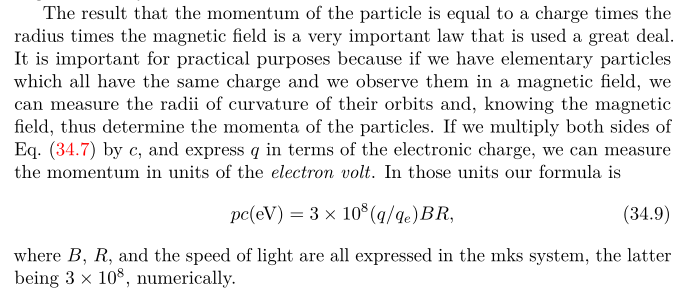
Pictures below are from 34-3 of Feynman's Lectures on physics. I can't understand the red line.

The $p$ is momentum, $c$ is light speed. I can't understand the red line. I feel the author think $pc$ is the kinetic energy, since the total energy should be rest energy adding kinetic energy.

But if it is kinetic energy, it should be $\frac{1}{2}mv^2$, which is not equal to $pc$, evenly $v\approx c$. So, what the $pc$ is ?
enter image description here

enter image description here

Qmechanic
  • 220,844
Enhao Lan
  • 437
  • 2
  • 12

2 Answers2

2

$pc$ is the total energy of a massless relativistic particle, like the photon. Electrons do have mass, so what's the catch?

Well, if the momentum of the electron is very big, then we can neglect the rest energy, so that $E=\sqrt{(pc)^2+(mc^2)^2}\approx pc$. A massive particle for which this approximation is valid is called an ultrarelativistic particle.

Finally, with respect to your confusion with kinetic energy, in SR, $KE = \sqrt{(pc)^2+(mc^2)^2} - mc^2$, which in the non-relativistic limit ($v/c \ll 1$) is the classical $m v^2/2$ (Taylor expand, while remembering that $p = \gamma mv$).

2

$$W=\sqrt{p^2c^2+m^2c^4}$$ approaches $W=pc$ for $p\gg mc$ and $W=mc^2+{p^2\over 2m} = mc^2+{1\over 2}mv^2$ for $p\ll mc$.

my2cts
  • 27,443