In this answer I addres a question raised the comments to the question.
So why does a projectile rotate clockwise, but air moves counterclockwise?
The cases of ballistic motion and motion of air mass are intrinsically different, for several different reasons.
The motion of a projectile is in first approximation a case of orbital motion (it's just that it's along an orbit that intersects the Earth surface.)
(Projectiles are subject to air friction, of course, which has to be accounted for, but the basis of the modeling is ballistic motion.
In the case of air mass:
The weight of the air mass is (ultimately) carried by the ground.
Obviously the lowest layer that is in direct contact with the ground is carried by the ground. All of the air of the atmosphere presses down; all of the weight is ultimately transferred to the ground.
The motion of the air mass of the atmosphere should be thought of as the motion of mass that is buoyant. Comparison: an airship is buoyant. An airship is very much not weightless; the weight of the airship is carried by the air pressure differential between bottom and top.
Once again the contrast with ballistic motion: during its flight a projectile is actually weightless.
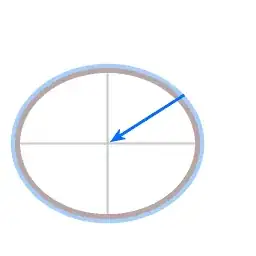
(Forces acting on buoyant mass)
In th image the flattened shape represents the Earth, the blue layer represents an average ocean depth.
Due to its rotation the Earth is an oblate spheroid. In the image the oblateness is exaggerated, the actual difference between polar radius and equatorial radius is about 21 kilometers.
The oceans are not deeper at the Equator. The reason for that: from the Equator to the poles is a downhill slope. That downhill slope provides centripetal force. Because of that centripetal force: on all latitudes the water that is co-rotating with the Earth has no tendency to migrate to another latitude.
In the diagram the blue arrow represents the force of gravity. (Specifically: the blue arrow represents the gravitational acceleration that would be experienced on non-rotating celestial body with that oblate shape.)
The red arrow represents the buoyancy force. The buoyancy force act perpendicular to the local level surface.
The green arrow represents the resultant of the blue arrow and the red arrow. The green arrow represents the centripetal force that acts on buoyant mass.
For the rest of the story I refer to my answer to the question:
How is the spin of hurricanes explained from an inertial frame?


