1

In Peskin & Schroeder, equation (7.2), I found this completeness relation for the momentum eigenstates $|\lambda_p\rangle$:

$$\mathbf 1=|\Omega\rangle\langle\Omega|+\sum_\lambda\int\frac{d^3p}{(2\pi)^2}\frac{1}{2E_{\mathbf p}(\lambda)}|\lambda_\mathbf p\rangle\langle\lambda_{\mathbf p}|.\tag{7.2}$$

Here $|\Omega\rangle$ is the vacuum, and $|\lambda_p\rangle$ represents the state with one particle labeled by $\lambda$ with momentum $p$. The $\lambda$ sum is over all types of particles in the theory. I can understand why we sum over all $\lambda$. However, I do not understand why we have to integrate state $\lambda_p$ over momentum space?

Qmechanic
  • 220,844
FIA
  • 11

1 Answers1

2

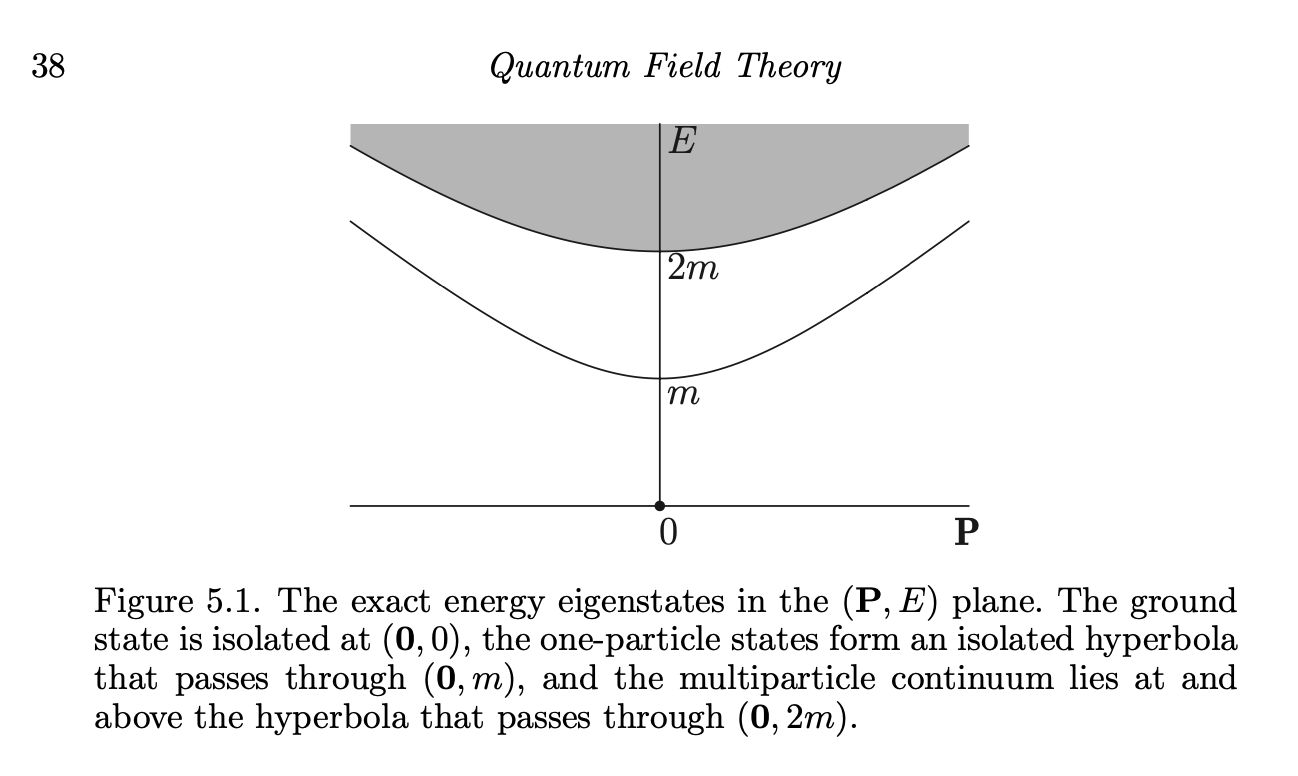
This is extremely similar to Srednicki Chapter 5 where he includes this picture (but sadly no completion relation similar to your text): enter image description here

This picture shows the entire set of eigenstates where there is a single vacuum state, a line of one particle states and then a multi-particle continuum. Thus my understanding of your formula is that $|\lambda_p\rangle$ does not necessarily represent a single particle state. In fact, in private correspondence with the author, he suggested I think about the states in this context with one label for momentum and another label $n$ that captures everything else; this is $\lambda$ here. Therefore, the $\lambda$ sum represents summing over every possible $0$ momentum state and the integral represents summing over every boosted (by ${\bf p}$) counterpart for each $|\lambda_{p=0}\rangle$ state. This way we are capturing the entire basis for the Hilbert space so this is a fine completeness relation.

JohnA.
  • 1,793