There is no atmosphere for comets to get hot and burn and show tails but they still have tails. Why do they?
Edit: Isn't the answer "acceleration"?
There is no atmosphere for comets to get hot and burn and show tails but they still have tails. Why do they?
Edit: Isn't the answer "acceleration"?


A simplistic answer according to the article "Comets: Formation, Discovery and Exploration" (Choi, 2010) is as the comet (which is a lump of 'dirty ice') approaches the sun, the radiation emitted causes the ice to melt into a 'coma', and then blown out into a tail in the solar wind.
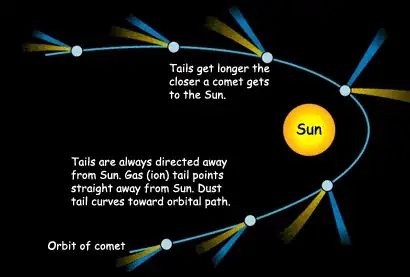
Going further, from the webpage "Why do some comets have two tails?", it is noted that the formation of the tail is actually in two parts, from the website:
The gas can be come 'photoionized' by the harsh ultraviolet light from the Sun, so that comet tails contain a complicated mixture of dust, ionized gas and neutral gas, illustrated below.
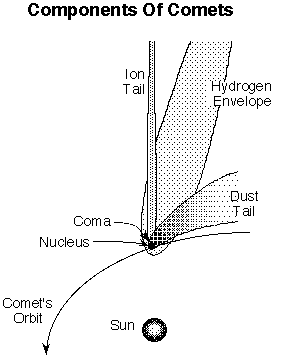
The reason for two tails that you see there is
cometary ionized and neutral gases go one way in space because they are effected by the magnetic fields and gases in the solar wind.
and
generally, the dust tails follow along the orbit of the comet
Two parts: Why is material lost by the comet? And why does it move away on the path it does?
Part 1: A comet is typically a few km in size. So gravity has less effect than, for example, near the Earth. Smaller particles can be driven off by out-gassing as the comet heats near the sun, and some atoms or ions can be driven away by the solar wind. The lesser gravity field means they are not so strongly held near the comet. So the combination means the comet has a bunch of "stuff" (gas, dust, ions, sometimes larger bits like flotsam driven off) near it as it gets near the sun.
Part 2: The path this material takes is affected by the solar wind, by the gravity of the comet, by the momentum the material had, and the gravity of the sun. The solar wind always pushes "out" from the sun. But the larger the particle the smaller its surface-to-mass ratio. So the relatively smaller the solar wind's effect. So larger particles that get separated tend to follow closer to the comet's orbit. Very small particles, such as single atoms, tend to go much closer to directly along with the solar wind.

